EU's 18th Russia Sanctions Package — What Changes for Your Business
EU's 18th sanctions package (July 2025) lowered the oil price cap, banned Nord Stream deals, and expanded the shadow fleet list. Find out what it means for you.
Legal status as of: 2026-05-20.
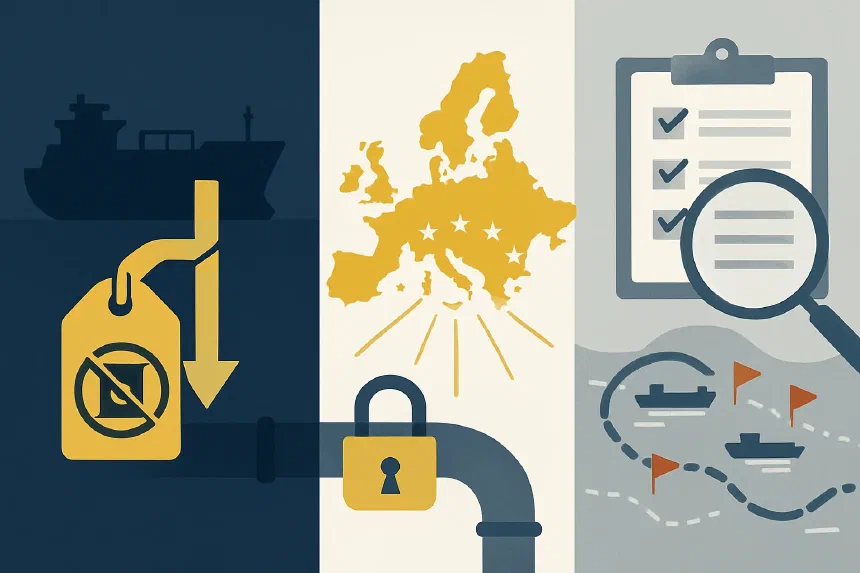
The EU’s 18th Russia sanctions package was published on 18 July 2025.1 It targets primarily Russia’s budgetary revenues from oil — lowering the oil price cap, banning transactions with Nord Stream, and blocking imports of refined products derived from Russian crude. For marine insurance and maritime logistics: direct consequences when underwriting cargo and reinsurance. For travel agencies, e-commerce businesses, and service companies: indirect consequences — new entries on the lists mean an obligation to re-screen counterparties.
Below you will find a 30-second summary, a discussion of the four key changes, a sector-by-sector impact assessment, and a concrete action checklist.
TL;DR — the key points in 30 seconds
- The 18th sanctions package was published on 18 July 2025.1
- The oil price cap for Russian crude oil was lowered from $60 to $47.6 per barrel; a dynamic mechanism was introduced that keeps the cap always 15% below the six-month rolling average market price of Urals crude.1
- A ban on transactions with Nord Stream 1 and Nord Stream 2 was introduced — covering entities operating the pipelines as well.1
- A new ban on imports of refined products derived from Russian crude oil applies even where refining took place in a third country.1
- The shadow fleet list grew to 444 vessels; the total number of individual personal and entity listings exceeded 2,500.12
- For marine insurers and logistics companies — direct impact on the verification of vessels and shipowners.
- For every business in Poland — a requirement to re-screen counterparties after 18 July 2025.
What the 18th package is and when it entered into force
A “sanctions package” is the common term for a set of legislative changes adopted by the Council of the EU in response to Russian aggression. It is not a single legal act — each package is a series of amendments to two base regulations: Council Regulation (EU) No 269/2014 of 17 March 2014 (lists of individuals and entities subject to asset freezes)3 and Council Regulation (EU) No 833/2014 of 31 July 2014 (sectoral and trade prohibitions).4 These may be accompanied by additional implementing regulations and decisions under the Common Foreign and Security Policy.
The 18th package was published in the Official Journal of the EU on 18 July 2025.1 As a general rule, EU regulations enter into force on the day following publication, unless the act contains an express alternative date or transitional period. The reference numbers of the specific amending regulations can be found in the OJEU from that date or on the DG FISMA website — the European Commission’s Directorate-General for Financial Stability, Financial Services and Capital Markets Union.5
The 18th package is the next step in a series of measures targeting Russia’s oil export revenues. The 15th package (December 2024) and 16th package (February 2025) focused on anti-circumvention and expanding the shadow fleet list.67 The 17th package (May 2025) was the largest single G7 action against the shadow fleet to date — adding 189 vessels.8 The 18th package struck at the crude oil pricing mechanism and gas pipeline infrastructure.
A full chronology of all 20 EU Russia sanctions packages is discussed in the article How many EU Russia sanctions packages are there, and what do they change for businesses?
What the 18th package changes — the main areas
1. Oil price cap lowered from $60 to $47.6 — with a dynamic mechanism
The oil price cap mechanism operates under Article 3n of Council Regulation (EU) No 833/2014.9 Prior to the 18th package, the ceiling was $60 per barrel of Russian crude oil. The 18th package lowered that figure to $47.6 and introduced a key structural change: an automatic, dynamic review mechanism that ensures the cap is always at least 15% below the six-month rolling average market price of Urals crude.1
What does this mean in practice? The previous cap was static — Russia could adapt its pricing policy and edge towards the limit. The new dynamic mechanism closes that loophole: when the market price of Urals falls, the cap automatically drops with it. What matters for your business is that any service connected with the transport or insurance of Russian crude oil must be verified against the current cap level — a check carried out several months ago is no longer sufficient.
The mechanism applies to businesses providing maritime transport, insurance, and financing services for tankers carrying Russian crude oil. An operator providing such services at prices above the cap is in breach of sanctions — regardless of whether it is an oil company.
2. Ban on transactions with Nord Stream 1 and Nord Stream 2
The 18th package introduces a ban on transactions with Nord Stream 1 and Nord Stream 2, covering entities operating those pipelines as well.1 Both pipelines were physically damaged in 2022, but the infrastructure — including the operating companies and pipeline-related assets — remained partly outside the direct reach of sanctions. The 18th package closed that gap.
For most businesses outside the energy sector, this ban has indirect relevance: companies linked to Nord Stream may have been counterparties or trading partners in various transactions not directly related to the pipelines. It is worth checking whether your counterparty list contains entities connected to those structures.
3. Ban on imports of refined products derived from Russian crude oil
The 18th package extends the trade prohibitions to cover imports of refined products derived from Russian crude oil — even where refining took place in a third country.1 This “traceback to Russian crude” principle closes the practice of indirect imports: you buy fuel in India, China, or Turkey, but if it was produced from Russian crude, the ban applies.
For businesses in the fuels, logistics, transport, and freight forwarding sectors: a review of the supply chain for the origin of petroleum products is required. This also applies to companies managing vehicle fleets or fuel storage that purchase petroleum products from intermediaries — due diligence now covers not only the direct supplier, but also the raw material.
4. Shadow fleet list expanded — 444 vessels, over 2,500 individual listings
The 18th package added further vessels to the shadow fleet list — the total grew to 444 units.1 At the same time, the total number of individual personal and entity listings on EU sanctions lists exceeded 2,500.2
The shadow fleet consists of tankers used to transport Russian crude oil in circumvention of the oil price cap: registered in third-party jurisdictions (Panama, Liberia, Marshall Islands, Comoros), often carrying falsified insurance documentation or operating with their AIS (Automatic Identification System) switched off. The ban on European companies insuring, chartering, and servicing these vessels is a direct prohibition on activity — not merely a recommendation.
For your business — even if you are not in the maritime sector — a growth of 55 individual listings in a single package1 means that last month’s list is out of date. Every subsequent counterparty scan must be based on the updated list.
Sectors most affected — and indirect significance for others
Marine insurance and reinsurance — direct impact
The marine insurance sector (P&I clubs, marine brokers, reinsurers) bears the consequences of the 18th package directly and immediately. Insuring vessels on the shadow fleet list is prohibited — after the 18th package, that list covers 444 units.1 Reinsuring policies covering such vessels is equally problematic: a European reinsurer that assumes risk under a policy issued on a listed vessel may be in breach of sanctions.
Polish insurance brokers and agents operating in the marine or cargo segment should have a procedure for verifying every shipowner and charterer before issuing or renewing a policy. A one-off check is insufficient — the list changes with each package, and packages appear every few months.
For more on the obligations in the insurance sector, see the article on sanction screening in the insurance industry.
Maritime logistics and freight forwarding — direct impact
Freight forwarding and logistics companies organising maritime transport are required to verify every vessel against the shadow fleet list. Arranging freight on a listed vessel, chartering such a unit, or providing bunkering services is prohibited. The 18th package extended the trade bans to include refined products derived from Russian crude — which may affect cargo that your company transports.
Travel agencies and OTAs — indirect impact
Travel agencies and online travel agency (OTA) operators do not deal in oil or tankers, but they are obliged to verify clients and counterparties against sanctions lists under Regulation 269/2014.3 Every new package that adds individual listings changes the list you must check. After the 18th package — with over 2,500 listings — the list is extensive and requires regular screening of the client and tour operator database.
Details of the obligations in the travel sector are described on the sector page for travel agencies and OTAs.
E-commerce and trade — indirect impact
An online shop selling to customers in various countries is required to verify every buyer against sanctions lists. The 18th package extended the trade prohibitions — if you sell petroleum or chemical products, you must check whether your goods are subject to the ban on imports from Russia (or products refined from Russian crude), and if you export goods through intermediaries to third countries — whether your contracts contain the “No re-export to Russia” clause required by Article 12g of Regulation 833/2014.10
A full discussion of obligations and risks for businesses in Poland, regardless of sector, is available in the article Who must carry out sanctions screening in Poland.
What to do after the 18th package enters into force — checklist
Below are four concrete steps your business should take following the publication of the 18th package (and every subsequent one).
Update the lists used for screening. Download the current lists from EUR-Lex (CELEX 32014R0269)3 or from the DG FISMA website.5 Note that the shadow fleet list has grown to 444 vessels — if you operate in maritime logistics or insurance, update your internal register of vessels subject to verification as well.
Screen counterparties against the updated lists. Having a procedure in place is not enough — you must be able to demonstrate that screening was carried out after the package entered into force. Record the date of the scan, the package number, and the result (CLEAR / POSSIBLE / MATCH) in your internal hits register. The documentation obligation arises from the Act of 13 April 2022 on special measures to counter support for aggression against Ukraine and to protect national security.11
If you operate in energy, logistics, or marine insurance — check CN codes and your supply chain. The 18th package extended bans to include refined products derived from Russian crude. Check whether your goods or supplied materials have any connection to Russian raw material — even through intermediaries in third countries. If you export banned goods through third countries, ensure your contracts include the “No re-export to Russia” clause (Article 12g of Regulation 833/2014).10
Update your internal compliance documentation. Every new scan and its result should be recorded in the register. If any contract requires legal review (e.g. a supplier in the supply chain turns out to be linked to a listed entity) — document the decision and consult a lawyer. A decision to suspend a transaction or to apply for a national derogation must be recorded with a date.
Check whether changes to the oil price cap affect services you provide or procure. If your business uses maritime freight or marine insurance services, ask your provider whether they have updated their procedures following the 18th package. A failure to update on the part of your provider may transfer risk to your business.
Penalties for ignoring the package
EU sanctions are directly applicable — they do not require implementation through Polish legislation to have legal force. The Polish Act of 13 April 2022 on special measures to counter support for aggression against Ukraine and to protect national security (Journal of Laws 2022, item 835)11 sets out the administrative penalties enforced by Polish authorities.
For a breach of the obligation to freeze funds or of the prohibition on making funds and resources available to listed persons or entities (arising from Regulation 269/20143 and Regulation 765/200612) — a financial penalty of up to PLN 20,000,000 is imposed by the Head of the National Revenue Administration (Szef KAS — Szef Krajowej Administracji Skarbowej) (Article 6(2) of the Act of 13 April 2022).13 The same authority — the Head of KAS — imposes a penalty of up to PLN 20 million for a breach of the ban on introducing Russian or Belarusian coal onto the territory of Poland (Article 12(2) of the same act).14
For allowing a listed person or entity to participate in a public procurement procedure, a penalty of up to PLN 20 million is imposed by the President of the Public Procurement Office (Prezes UZP — Urząd Zamówień Publicznych) (Article 7(7) of the Act of 13 April 2022).15
At EU level, Directive (EU) 2024/1226 of the European Parliament and of the Council of 24 April 2024 introduces the criminalisation of breaches of EU sanctions.16 The transposition deadline for this directive has passed — Poland is implementing its provisions through a national implementing bill. The specific penalty ranges — both for natural persons and for legal entities — will be set out in the Polish implementing act; this article will be updated once it is adopted.
A full discussion of penalties and liability for breaching EU sanctions in Poland is available in the article What penalties apply for breaching sanctions in Poland and the EU.
FAQ
When did the EU’s 18th sanctions package enter into force?
The EU’s 18th Russia sanctions package was published on 18 July 2025 in the Official Journal of the EU.1 EU regulations generally enter into force on the day following publication, unless the act specifies a different date or a transitional period for certain provisions.
What exactly does the 18th package change for the insurance sector?
Two direct changes: (1) the shadow fleet list grew to 444 vessels — insuring or reinsuring those vessels is prohibited; (2) the total number of individual personal and entity listings exceeded 2,500.12 A marine broker or insurer must update their procedures for verifying shipowners, charterers, and vessels after every new package.
Does the oil price cap affect my business if I do not trade in oil?
The oil price cap mechanism (Article 3n of Regulation 833/2014)9 applies to entities providing maritime transport, insurance, and financing services for tankers carrying Russian crude oil. If your business is not involved in any way in those service chains, the cap does not directly affect you. However, if you are a freight forwarder, a ship-leasing company, a marine broker, or a cargo insurer — the mechanism is critical for you.
Where can I download the current sanctions lists after the 18th package?
Three primary sources: the package chronology on the DG FISMA website5, the EUR-Lex database (CELEX 32014R0269 for the persons list)3, and the Polish sanctions list maintained by the MSWiA (Ministry of Internal Affairs and Administration — Ministerstwo Spraw Wewnętrznych i Administracji) available at gov.pl.17 Current lists of sanctioned entities are also available via the EU Sanctions Map (sanctionsmap.eu).18
How many EU sanctions packages against Russia are there in total?
As of May 2026, the EU has adopted 20 sanctions packages against Russia.19 The 18th package (July 2025) was the penultimate before the 19th (October 2025) and 20th (April 2026) packages. A full chronology and overview of each package is available in the article How many EU Russia sanctions packages are there, and what do they change for businesses?
Does the 18th package cover sanctions against Belarus?
Not directly. Sanctions against Belarus are based on a separate act — Council Regulation (EC) No 765/2006 of 18 May 200612 — with its own packages and numbering. The Polish MSWiA sanctions list covers persons and entities from both regimes — Russian and Belarusian. Always screen against both lists.
How Sanqto can help
Sanqto is sanctions screening software installed on-premise — within your company’s own infrastructure, without transmitting counterparty data to an external provider’s cloud. The system operates on a three-state MATCH / POSSIBLE / CLEAR model: instead of a binary signal, it gives the compliance officer decision-making space for ambiguous hits — such as a similar name, a typographical error, or a change in the entity’s legal form. Response time per query is under 30 ms, allowing you to verify counterparties without blocking sales, booking, or policy-processing workflows. After every new package, the lists in the system are updated automatically — you do not need to monitor the Official Journal of the EU every Monday. The software is accompanied by a set of implementation documents: a sanctions policy, a role-based procedure, a hits register, and a risk assessment — ready to be presented at an inspection by the Head of KAS or MSWiA. Details of the offering for the insurance sector are described on the Sanqto for insurance page.
Legal basis
Base EU acts (Russia sanctions):
- Council Regulation (EU) No 269/2014 of 17 March 2014 concerning restrictive measures in respect of actions undermining or threatening the territorial integrity, sovereignty and independence of Ukraine — EUR-Lex CELEX:32014R0269
- Council Regulation (EU) No 833/2014 of 31 July 2014 concerning restrictive measures in view of Russia’s actions destabilising the situation in Ukraine — EUR-Lex CELEX:32014R0833
- Council Decision 2014/512/CFSP — act accompanying Regulation 833/201420
Base EU act (Belarus):
- Council Regulation (EC) No 765/2006 of 18 May 2006 concerning restrictive measures in view of the situation in Belarus and the involvement of Belarus in the Russian aggression against Ukraine12
EU Directive:
- Directive (EU) 2024/1226 of the European Parliament and of the Council of 24 April 2024 on the definition of criminal offences and penalties for the violation of Union restrictive measures — EUR-Lex CELEX:32024L122616
Polish legislation:
- The Act of 13 April 2022 on special measures to counter support for aggression against Ukraine and to protect national security — Journal of Laws 2022, item 835, ISAP11
Institutions and reference materials:
- DG FISMA — Russia sanctions chronology — chronology + links to all packages5
- DG FISMA — 18th package (18 July 2025)1
- Polish MSWiA sanctions list17
- DG FISMA — No re-export to Russia clause (Article 12g)10
- DG FISMA — Provision of services FAQ (Article 5n)21
Information, not legal advice. This article is for informational and educational purposes only. It does not constitute legal advice. Legal status as of: 20 May 2026. The specific obligations of your business depend on your activity profile, CN codes for goods, counterparties, and require individual assessment — if in doubt, consult a lawyer or compliance adviser.
18th package — published 18 July 2025; oil price cap lowered from $60 to $47.6 with dynamic mechanism; ban on transactions with Nord Stream 1 and 2; ban on imports of refined products derived from Russian crude; 444 shadow fleet vessels; over 2,500 individual listings; 55 additional listings; DG FISMA news. ↩︎ ↩︎ ↩︎ ↩︎ ↩︎ ↩︎ ↩︎ ↩︎ ↩︎ ↩︎ ↩︎ ↩︎ ↩︎ ↩︎ ↩︎ ↩︎
Total number of individual listings after the 18th package exceeded 2,500; DG FISMA — 18th package. ↩︎ ↩︎ ↩︎
Council Regulation (EU) No 269/2014 of 17 March 2014 concerning restrictive measures in respect of actions undermining or threatening the territorial integrity, sovereignty and independence of Ukraine — EUR-Lex CELEX:32014R0269; title confirmed in the Act of 13 April 2022, ISAP. ↩︎ ↩︎ ↩︎ ↩︎ ↩︎
Council Regulation (EU) No 833/2014 of 31 July 2014 concerning restrictive measures in view of Russia’s actions destabilising the situation in Ukraine — EUR-Lex CELEX:32014R0833; referenced in DG FISMA. ↩︎
DG FISMA — Directorate-General for Financial Stability, Financial Services and Capital Markets Union; official website. ↩︎ ↩︎ ↩︎ ↩︎
15th package — published 16 December 2024; Council Regulation (EU) 2024/3192; 52 new shadow fleet vessels (79 total); DG FISMA news. ↩︎
16th package — published 24 February 2025; 74 new vessels (153 total); 83 new listings (48 individuals + 35 entities); ban on imports of primary Russian aluminium; DG FISMA news. ↩︎
17th package — published 20 May 2025; 189 new vessels (342 total) — largest single G7 action against the shadow fleet; 75 new listings (17 individuals + 58 entities); DG FISMA news. ↩︎
Article 3n of Regulation 833/2014 — oil price cap mechanism for Russian crude oil; referenced in DG FISMA. ↩︎ ↩︎
Article 12g of Regulation 833/2014 — “No re-export to Russia” clause; DG FISMA — No re-export to Russia clause FAQ. ↩︎ ↩︎ ↩︎
The Act of 13 April 2022 on special measures to counter support for aggression against Ukraine and to protect national security — Journal of Laws 2022, item 835, ISAP. ↩︎ ↩︎ ↩︎
Council Regulation (EC) No 765/2006 of 18 May 2006 concerning restrictive measures in view of the situation in Belarus and the involvement of Belarus in the Russian aggression against Ukraine — title confirmed in the Act of 13 April 2022, ISAP. ↩︎ ↩︎ ↩︎
Article 6(1) and (2) of the Act of 13 April 2022 — a financial penalty of up to PLN 20,000,000 for a breach of the asset-freeze obligation (Regulations 269/2014 and 765/2006) is imposed by the Head of KAS; ISAP API text. ↩︎
Articles 8 and 12(1) and (2) of the Act of 13 April 2022 — prohibition on introducing Russian/Belarusian coal onto the territory of Poland (CN codes 2701 and 2704); a penalty of up to PLN 20,000,000 is imposed by the Head of KAS; ISAP API text. ↩︎
Article 7(6) and (7) of the Act of 13 April 2022 — a penalty of up to PLN 20,000,000 for allowing a listed person or entity to participate in a public procurement procedure is imposed by the President of the Public Procurement Office (Prezes UZP); ISAP API text. ↩︎
Directive (EU) 2024/1226 of the European Parliament and of the Council of 24 April 2024 — criminalisation of EU sanctions violations; EUR-Lex CELEX:32024L1226. Detailed provisions of the directive to be confirmed during fact-checking. ↩︎ ↩︎
List of persons and entities subject to sanctions — Ministry of Internal Affairs and Administration (MSWiA), gov.pl/web/mswia. ↩︎ ↩︎
EU Sanctions Map (sanctionsmap.eu) — interactive map of EU sanctions regimes maintained by the General Secretariat of the Council of the EU / EEAS. ↩︎
Total of 20 packages against Russia as of 23 April 2026; DG FISMA — Russia sanctions chronology. ↩︎
Council Decision 2014/512/CFSP — act accompanying Regulation 833/2014; referenced in DG FISMA. ↩︎
Article 5n of Regulation 833/2014 — prohibition on providing certain services to the Government of Russia and legal persons established in Russia; DG FISMA — Provision of services FAQ. ↩︎