EU's 19th sanctions package against Russia — LNG, shadow fleet, crypto assets
EU's 19th sanctions package (October 2025): full LNG import ban, 557 shadow-fleet vessels, and the first EU sanctions on crypto exchanges and third-country banks.
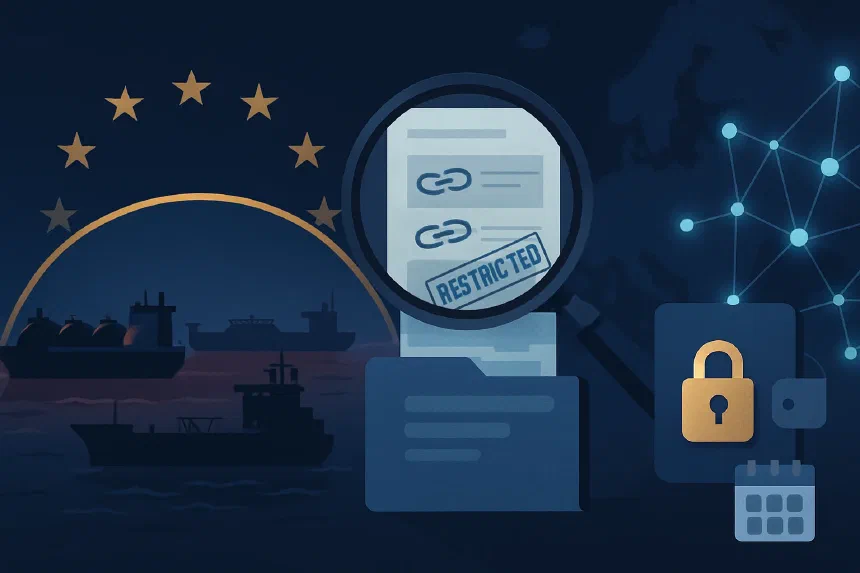
The EU’s nineteenth sanctions package against Russia was published on 23 October 2025 and is one of the most far-reaching sets of measures since the start of the full-scale invasion.1 This is no longer just a matter of updated named lists and commodity codes — the 19th package strikes at Russian LNG (Liquefied Natural Gas) exports, the two largest Russian oil companies, vessels circumventing the embargo, and — for the first time in EU history — the crypto-asset sector.
If you run a company in Poland and trade in gas, underwrite marine cargo, process cryptocurrency transfers, or have counterparties in Central Asia or the Middle East, this package affects you directly. Below you will find everything you need to know, without banking law in the background.
Legal status as of: 2026-05-20.
TL;DR — what to remember in 90 seconds
- Ban on Russian LNG imports in two phases: short-term contracts — ban after 6 months from the package’s entry into force; long-term contracts — ban from 1 January 2027.1
- Note the distinction: the 19th package covers LNG (Liquefied Natural Gas, CN code 2711 11 00), not LPG (Liquefied Petroleum Gas, propane-butane). The ban on Russian LPG imports was introduced earlier, in the 6th package of 2022.2
- Rosneft and Gazprom Neft are subject to a full transaction ban — no EU entity may enter into contracts with them or settle payments.1
- The shadow fleet has grown to 557 vessels on the EU list — every insurer and marine broker must verify vessels before issuing a policy.1
- First-ever sanctions on crypto assets in the context of Russia — selected Russian virtual asset service providers (VASPs) have been added to the list.1
- Third-country banks helping to circumvent sanctions — covered by the anti-circumvention regime for the first time.1
- In Poland, a breach carries a fine of up to PLN 20,000,000 (Article 6(2) of the Act of 13 April 2022).3
What the 19th package is and when it entered into force
The European Union has built its sanctions regime against Russia on two base Council Regulations: Council Regulation (EU) No 269/2014 of 17 March 2014 — containing named lists of individuals and entities subject to asset freezes — and Council Regulation (EU) No 833/2014 of 31 July 2014 — governing sectoral and trade prohibitions.45 Each successive package is a series of amendments to those two acts, sometimes supplemented by new implementing acts.
The nineteenth package was published in the Official Journal of the EU on 23 October 2025 and entered into force the following day.1 It is the nineteenth set of amendments since 23 February 2022, when the EU adopted the first package of sanctions in response to Russia’s recognition of the Donetsk and Luhansk oblasts.6 For a full chronology of all packages from the 1st to the 20th, see the article How many EU sanctions packages against Russia are there, and what do they change for businesses?.
In terms of scope, the 19th package is exceptional — it touches energy, maritime and financial infrastructure simultaneously, and two of its five elements (crypto assets, third-country banks) had no precedent in any earlier package.
The LNG import ban — what it covers exactly (and how it differs from LPG)
What LNG is
LNG (Liquefied Natural Gas) is natural gas cooled to approximately −162 °C; in that form its volume shrinks by more than 600 times and it can be transported by LNG tankers (methane carriers). The CN code for LNG is 2711 11 00. It is an entirely different product from LPG (Liquefied Petroleum Gas) — a mixture of propane and butane used, among other things, for heating, gas hobs and as vehicle fuel.
What the 19th package introduced
The 19th package imposed a full ban on the import of Russian LNG into the EU.1 The ban operates in two phases depending on contract type:
- Short-term contracts: import banned after 6 months from the package’s entry into force (i.e. from 24 October 2025).1
- Long-term contracts: import banned from 1 January 2027.1
If you are a gas importer or energy distributor with a contract for deliveries of Russian LNG, you need to establish whether it is a short-term or long-term contract and plan a wind-down or renegotiation schedule in line with the applicable deadline. Sanctions clauses in supply contracts have ceased to be a formality; they are now the exit mechanism.
LNG vs LPG — a common misconception
Media reports regularly carry the misleading shorthand that the 19th package “bans LPG”. That is incorrect. The ban on importing LPG (propane-butane, CN codes 2711 12–19) from Russia was introduced as long ago as the 6th sanctions package of 3 June 2022 and has been part of the EU’s basic energy sanctions regime for more than three years.2 The 19th package added the LNG ban on top of it — so from October 2025 both types of Russian liquefied gas are subject to an import prohibition.
For your company, the practical question is straightforward: do you buy or distribute gas that originates from Russia? If so, check the CN code of the product and the date from which the specific ban applies.
The shadow fleet — 557 vessels and what that means for insurers and logistics
What the shadow fleet is
The shadow fleet consists of tankers transporting Russian crude oil and its refined products while bypassing the oil price cap mechanism (the ceiling imposed by the G7 and the EU, administered under Article 3n of Regulation 833/2014).7 These vessels are registered in third-country jurisdictions — Panama, Liberia, the Marshall Islands, the Comoros — and frequently operate with falsified or out-of-date insurance documentation and with their AIS (Automatic Identification System — the navigational transponder that identifies a vessel) switched off.
Listing a vessel on the EU list means a practical ban on that vessel calling at EU ports, and a prohibition on EU entities providing it with insurance or logistics services.
Scale after the 19th package
The 19th package added further vessels and brought the total number of units on the list to 557.1 For context: after the 15th package (December 2024) the total stood at 79 vessels8; after the 17th package (May 2025) — 3429; after the 18th package (July 2025) — 444.10 In less than a year the shadow fleet on the EU list grew sevenfold.
For Polish insurers, marine brokers, cargo agents and freight-forwarding companies, this creates a concrete obligation: before issuing a policy, signing a charter agreement or accepting a freight order, you must verify that the vessel in question does not appear on the list. The database is updated with each new package — a check carried out several months ago is no longer sufficient.
Further information on the obligations facing the insurance sector is available on the sanction screening in insurance page.
Sanctions on crypto assets and third-country banks
The EU’s first-ever sanctions on the crypto sector
The 19th sanctions package introduced something unprecedented: the EU’s first-ever sanctions targeting the crypto-asset sector in the context of Russia.1 Selected Russian VASPs — Virtual Asset Service Providers — have been added to the list. In plain terms: cryptocurrency exchanges, currency brokers and exchange platforms that serve Russian clients or listed entities and are used to circumvent financial sanctions.
For Polish companies active in fintech, cryptocurrency exchange, trading platforms and DeFi, this means an obligation to update KYC (Know Your Customer — verification of the identity of the client and the originator of a transaction) procedures and to add the new entities to the sanction-screening database. If you process transfers to or from Russian platforms, you must check whether that platform has been added to the list. The absence of verification is no shield against liability — EU sanctions law operates on the basis of strict liability (liability without the need to prove intent).
Banks outside the EU and Russia — the anti-circumvention mechanism
For the first time, the 19th package imposed restrictions on financial institutions from third countries — outside the European Union and outside Russia — that had been helping Russian entities to circumvent previously imposed sanctions.1 This is an extension of the anti-circumvention mechanism that the EU has been developing since the 11th package of 2023.11
If your company settles transactions in foreign currencies with partners in Central Asia (Kazakhstan, Uzbekistan, Armenia), the Caucasus, the United Arab Emirates or Turkey, check whether the bank intermediating the transaction or the correspondent bank of your counterparty has been added to the new list. A transaction processed through a sanctioned financial institution may constitute a breach of the prohibition under Article 2 of Regulation 269/2014,4 even if the ultimate beneficiary does not appear on any named list.
Which Polish companies are affected by the 19th package
The 19th package is not solely a problem for the financial sector or large energy corporations. The following is a summary of the sectors that need to act:
Gas importers and distributors: the ban on importing Russian LNG means reviewing contracts, updating sanctions clauses and preparing a wind-down plan in line with the applicable deadline for the contract type (6 months or 1 January 2027).1
Insurers and marine brokers: the expansion of the shadow-fleet list to 557 vessels imposes an obligation to verify every vessel before issuing a policy or accepting reinsurance. An out-of-date screening creates the risk of providing insurance cover to a sanctioned tanker — which constitutes a breach of the law.1 Details of sector-specific obligations are set out in the sanction screening for insurers section.
Fintech companies, cryptocurrency exchange services and trading platforms: new Russian VASP entries on EU lists require the immediate updating of screening databases. Conducting a transaction with a sanctioned entity — even unintentionally — is a breach of EU law.1
Companies trading with counterparties in Central Asia, the UAE and Turkey: the extension of sanctions to third-country banks means you must verify not only the counterparty but also the bank intermediating the settlement. The anti-circumvention mechanism extends liability to the entire transaction chain.1
Travel agencies, estate agents, e-commerce businesses: the 19th package, like every preceding one, expands the named lists of individuals and entities. The obligation to screen counterparties arising from the Act of 13 April 2022 on special measures to counter support for aggression against Ukraine applies to every company, not only to the financial sector.123 Check whether your company has an obligation to conduct sanction screening.
It is worth remembering that the EU sanctions list is a living document — each new package adds named entries that require a fresh screening of the counterparty database.
Checklist — what to do after the 19th package
The steps below relate to the 19th package but also constitute a general procedure that is worth repeating after each subsequent package.
Establish whether your company is in the risk zone. Check: (a) whether you import or distribute Russian LNG; (b) whether you insure or freight marine cargo; (c) whether you process cryptocurrency transactions; (d) whether you have counterparties in Central Asia, the UAE or Turkey with settlements through local banks. If at least one answer is yes, you fall within the scope of the 19th package.
Update your screening database with new entries. Download the current version of the lists from EUR-Lex (CELEX 32014R0269)4 or from the DG FISMA website1 and upload them to your verification system. Screen all active counterparties — not only new ones. Pay particular attention to entries relating to Rosneft, Gazprom Neft and Russian VASPs.
Vessel verification (for insurers and logistics). Download the current shadow-fleet list from the DG FISMA database. Before issuing a policy or accepting a cargo order, check the IMO number (the vessel’s identification number) against the updated register. Remember: after the 19th package the list contains 557 vessels, and after the 20th it stands at 632.13
Review contracts with energy partners. If you hold a contract for deliveries of Russian LNG, establish whether it is short-term (ban after 6 months) or long-term (ban from 1 January 2027) and plan a wind-down or renegotiation schedule accordingly. Update your sanctions clauses.1
Document the screening carried out. Record the date of verification, the result (CLEAR / POSSIBLE / MATCH) and the version of the list on which the check was based. A register of hits is evidence of due diligence in the event of an inspection by the National Revenue Administration (KAS — Krajowa Administracja Skarbowa) or the Ministry of the Interior and Administration (MSWiA — Ministerstwo Spraw Wewnętrznych i Administracji).1214
FAQ
When did the EU’s 19th sanctions package enter into force?
The EU’s nineteenth sanctions package against Russia was published in the Official Journal of the EU on 23 October 2025 and entered into force the following day — 24 October 2025.1
What is the difference between LNG and LPG in the context of sanctions?
LNG (Liquefied Natural Gas) is liquefied natural gas transported by LNG tankers (CN code 2711 11 00). LPG (Liquefied Petroleum Gas) is liquid gas — a mixture of propane and butane — used, among other things, as vehicle fuel and for heating. The ban on importing Russian LPG has been in force since the 6th sanctions package of 3 June 2022.2 The ban on importing Russian LNG was only introduced by the 19th package of October 2025.1
What does a full transaction ban on Rosneft and Gazprom Neft mean?
A full transaction ban means that no entity registered or operating in the EU may enter into any contracts, make payments or provide services to Rosneft, Gazprom Neft or their subsidiaries — without first obtaining an individual derogation from the competent national authority.1 Unlike earlier packages, which introduced partial restrictions (such as a ban on new investments), the 19th package subjects all business relations to a full prohibition.
Who is affected by the crypto-asset sanctions?
The crypto-asset sanctions in the 19th package affect companies and individuals in the EU that provide cryptocurrency services — exchanges, brokers, trading platforms, wallet providers and settlement intermediaries. If you operate or process a cryptocurrency transfer, you are obliged to check whether the other party to the transaction appears on the list as a sanctioned VASP (Virtual Asset Service Provider).1 The rule is the same as for traditional financial transactions — failure to verify does not absolve you of liability.
How many shadow-fleet vessels are on the EU list after the 19th package?
After the 19th package (October 2025) the list covered a total of 557 vessels.1 For comparison: after the 15th package (December 2024) there were 79.8 After the 20th package (April 2026) the number rose to 632.13
Does the 19th package apply to companies outside the financial sector?
Yes. Although media coverage focuses on banks and energy companies, every company in the EU is obliged to comply with the sanctions flowing from Council Regulation (EU) No 269/2014.4 In Poland, the Act of 13 April 2022 on special measures to counter support for aggression against Ukraine and to protect national security imposes additional obligations and penalties — including a fine of up to PLN 20,000,000 for breaching the obligation to freeze funds or the prohibition on transacting with a listed entity (Article 6(2) of the Act of 13 April 2022, imposed by the Head of KAS).3
How Sanqto can help
Each new sanctions package creates one concrete task for your company: re-screening all active counterparties against updated lists. Sanqto is sanction-screening software installed on-premise — within your own infrastructure, so counterparty data never leaves your network. The system automatically downloads updates from DG FISMA lists, the Polish MSWiA list15 and the EU Sanctions Map, so you do not need to monitor the Official Journal of the EU after every package. Counterparty verification follows the MATCH / POSSIBLE / CLEAR model — three states rather than a binary green/red give a compliance officer decision-making room for ambiguous hits. The software comes with a set of implementation documents (sanctions policy, desk procedure, hits register) ready for a KAS or MSWiA inspection. More on who is subject to the sanction-screening obligation in Poland is covered in a separate article — and which sanctions lists you need to check is set out in our list overview.
Legal basis
The following sources have verified status from the sources.json database.
- Council Regulation (EU) No 269/2014 of 17 March 2014 concerning restrictive measures in respect of actions undermining or threatening the territorial integrity, sovereignty and independence of Ukraine — EUR-Lex CELEX:32014R0269
- Council Regulation (EU) No 833/2014 of 31 July 2014 concerning restrictive measures in view of Russia’s actions destabilising the situation in Ukraine — EUR-Lex CELEX:32014R0833
- Council Decision 2014/512/CFSP — the act accompanying Regulation 833/2014 — DG FISMA
- The Act of 13 April 2022 on special measures to counter support for aggression against Ukraine and to protect national security (Journal of Laws 2022, item 835; consolidated text Journal of Laws 2025, item 514) — ISAP
- Article 3n of Regulation 833/2014 — the oil price cap mechanism for Russian crude oil — DG FISMA
- Article 5n of Regulation 833/2014 — prohibition on providing certain services to Russian entities — DG FISMA — Provision of services FAQ
- Article 12g of Regulation 833/2014 — the “No re-export to Russia” clause (introduced by the 11th package, 23 June 2023) — DG FISMA — No re-export to Russia clause FAQ
- 19th package — DG FISMA news (23 October 2025) — finance.ec.europa.eu
- 15th package — Council Regulation (EU) 2024/3192 — 52 new shadow-fleet vessels — DG FISMA news
- 17th package — DG FISMA news (20 May 2025) — finance.ec.europa.eu
- 18th package — DG FISMA news (18 July 2025) — finance.ec.europa.eu
- 20th package — DG FISMA news (23 April 2026) — finance.ec.europa.eu
- Polish sanctions list (MSWiA) — gov.pl/web/mswia
- DG FISMA — chronology of all Russia sanctions packages — finance.ec.europa.eu
Footnotes
Information, not legal advice. This article is for informational and educational purposes only. It does not constitute legal advice. Legal status as of: 20 May 2026. The specific obligations applicable to your company depend on its business profile, the CN codes of the goods you handle, and your counterparties, and require individual assessment — if in doubt, consult a lawyer or compliance adviser.
Package 19 — published 23 October 2025; full ban on LNG imports (long-term from 1 January 2027; short-term after 6 months); full transaction ban for Rosneft and Gazprom Neft; 557 shadow-fleet vessels; first crypto sanctions; sanctions on third-country banks; DG FISMA news. ↩︎ ↩︎ ↩︎ ↩︎ ↩︎ ↩︎ ↩︎ ↩︎ ↩︎ ↩︎ ↩︎ ↩︎ ↩︎ ↩︎ ↩︎ ↩︎ ↩︎ ↩︎ ↩︎ ↩︎ ↩︎ ↩︎ ↩︎ ↩︎
Energy sanctions — ban on imports of coal, peat and LPG, and of crude oil by sea; the oil price cap mechanism (Article 3n); DG FISMA — Energy. ↩︎ ↩︎ ↩︎
Article 6(1) and (2) of the Act of 13 April 2022 — a financial penalty of up to PLN 20,000,000 for breaching the obligation to freeze funds (under Regulations 269/2014 and 765/2006) is imposed by the Head of KAS (Krajowa Administracja Skarbowa — National Revenue Administration); ISAP API text. ↩︎ ↩︎ ↩︎
Council Regulation (EU) No 269/2014 of 17 March 2014 concerning restrictive measures in respect of actions undermining or threatening the territorial integrity, sovereignty and independence of Ukraine — EUR-Lex CELEX:32014R0269; title confirmed in the Act of 13 April 2022, ISAP. ↩︎ ↩︎ ↩︎ ↩︎
Council Regulation (EU) No 833/2014 of 31 July 2014 concerning restrictive measures in view of Russia’s actions destabilising the situation in Ukraine — EUR-Lex CELEX:32014R0833; quoted from DG FISMA. ↩︎
Package 1 — first sanctions, published 23 February 2022; DG FISMA news. ↩︎
Article 3n of Regulation 833/2014 — the oil price cap mechanism for Russian crude oil; quoted from DG FISMA. ↩︎
Package 15 — published 16 December 2024; Council Regulation (EU) 2024/3192; 52 new shadow-fleet vessels (79 in total); DG FISMA news. ↩︎ ↩︎
Package 17 — published 20 May 2025; 189 new vessels (342 in total); DG FISMA news. ↩︎
Package 18 — published 18 July 2025; oil price cap reduced from USD 60 to USD 47.6; Nord Stream 1 and 2; ban on importing refined products from Russian crude; 444 shadow-fleet vessels; DG FISMA news. ↩︎
Package 11 — published 23 June 2023; introduction of the “No re-export” clause (Article 12g); DG FISMA news. ↩︎
The Act of 13 April 2022 on special measures to counter support for aggression against Ukraine and to protect national security — Journal of Laws 2022, item 835, ISAP. ↩︎ ↩︎
632 vessels in total on the EU shadow-fleet list after the 20th package (23 April 2026); DG FISMA — package 20. ↩︎ ↩︎
Article 2(1) and Article 3(3) of the Act of 13 April 2022 — the Polish sanctions list is maintained by the minister responsible for internal affairs (MSWiA — Ministerstwo Spraw Wewnętrznych i Administracji, Ministry of the Interior and Administration); ISAP API text. ↩︎
List of persons and entities subject to sanctions — Ministry of the Interior and Administration (MSWiA), gov.pl/web/mswia. ↩︎