Russia Embargo — a Practical Guide for Exporting and Importing Companies
What the Russia embargo is, which goods it covers, and how to check a CN code in the TARIC database. A practical guide for Polish SMEs that export or import goods.
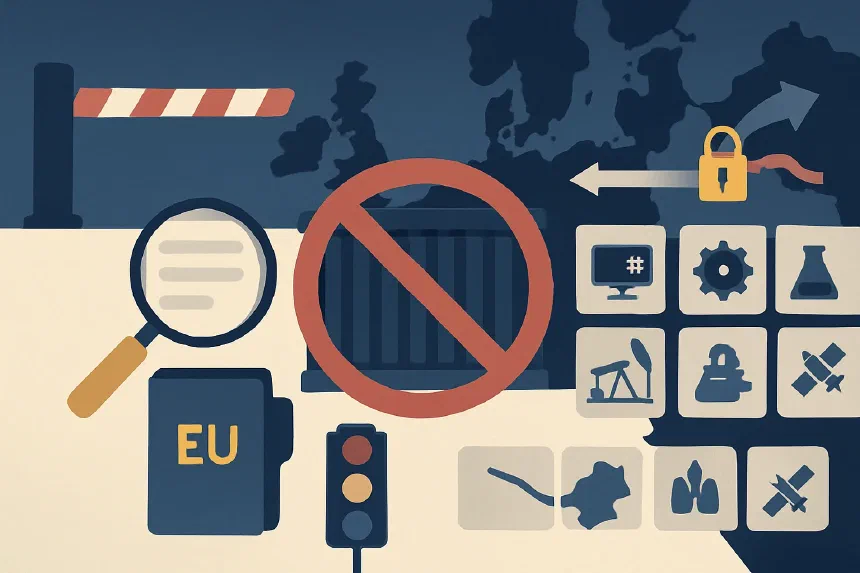
The Russia embargo is not merely a media topic — it is a set of concrete legal prohibitions that apply to your company by virtue of European Union regulations, directly and without any need for national implementation. If you export goods, import raw materials, or plan to sell to customers in third countries, you need to know which products are banned and how to verify this before your goods reach customs clearance.
This article explains what a sectoral embargo is, how to distinguish it from individual sanctions, which categories of goods are subject to the prohibition, and how to check your specific product step by step using official EU tools.
Legal status as of: 2026-05-20.
TL;DR — the key points in 60 seconds
- An embargo is a prohibition on trading in certain goods or services — distinguish it from individual sanctions (freezing the assets of specific persons on a sanctions list). Both mechanisms operate in parallel.1
- The legal basis for the Russia embargo is primarily Council Regulation (EU) No 833/2014 of 31 July 2014, as amended by all 20 sanctions packages.1
- The embargo covers, among other things: dual-use goods and technologies, advanced military technologies, luxury goods, energy commodities (import of oil and gas), and steel and iron.1
- The CN code (Combined Nomenclature) is an 8-digit product identifier — knowing it allows you to establish definitively whether your product is subject to a ban. You check it in the European Commission’s TARIC database.2
- Since the 11th package (23 June 2023), the “No re-export to Russia” clause has been in force — an EU exporter must obtain a written declaration from the buyer in a third country confirming that the goods will not be redirected to Russia.34
- Violating the embargo carries a financial penalty of up to PLN 20,000,000 imposed by the Head of the National Revenue Administration (KAS — Krajowa Administracja Skarbowa),5 and — since 2024 — criminal liability under Directive (EU) 2024/1226.6
What an embargo is and how it differs from individual sanctions
The word “sanctions” in fact covers two distinct legal mechanisms that are often confused even by compliance professionals. It is worth separating them, because violating each one involves a different verification procedure and a different scope of liability.
Individual sanctions (also called targeted sanctions) consist of freezing the financial funds and economic resources of specific natural persons or entities named on a sanctions list. If your counterparty appears on that list, you cannot enter into any transactions with them — regardless of the type of goods or services involved. The legal basis for these sanctions is Council Regulation (EU) No 269/2014 of 17 March 2014.7
An embargo (sectoral sanctions) works differently: it prohibits trading in certain categories of goods or services — regardless of whether your counterparty appears on any list. Even if the buyer is a company with no Russia-related listing, a transaction involving a prohibited good is illegal. The legal basis for the Russia embargo is Council Regulation (EU) No 833/2014 of 31 July 2014.1
In practice, both mechanisms must be checked simultaneously and independently: first you verify the counterparty against the lists (whether they are a person or entity subject to sanctions), and then you check the goods or service (whether the transaction is permitted at all, regardless of the party involved). Omitting either of these steps is a potential sanctions violation.
Legal basis of the Russia embargo
The main act governing the embargo on goods and services in dealings with Russia is Council Regulation (EU) No 833/2014 of 31 July 2014 concerning restrictive measures in view of Russia’s actions destabilising the situation in Ukraine (CELEX 32014R0833).1 The Regulation entered into force almost simultaneously with Russia’s annexation of Crimea and has been expanded over the years by successive sanctions packages.
An EU regulation has direct effect in all Member States — it requires no implementation into national law and applies from the date it enters into force, equally in Poland, France, and Germany.8 This means you cannot invoke the absence of a national provision: if Regulation 833/2014 prohibits a given transaction, that prohibition applies to your company directly from the text of the EU act.
By May 2026, the EU had adopted a total of 20 sanctions packages against Russia, each of which broadened the scope of the embargo by adding new categories of goods, new CN codes, and new service prohibitions.9 The latest, 20th package entered into force on 23 April 2026. This means that the list of prohibited goods significantly exceeds what was contained in the original 2014 text of the regulation — a verification carried out a year ago may already be out of date.
At the national level, the Act of 13 April 2022 on special solutions for countering support for aggression against Ukraine and for the protection of national security (Journal of Laws 2022, item 835)10 supplements the EU regulation by introducing a national sanctions list and a national penalty system. Polish law does not replace the EU regulation — it operates alongside it, supplementing it with national enforcement mechanisms.
For more on the successive packages and their chronology, see the article What do EU sanctions against Russia mean for your company?
Which categories of goods are covered by the embargo
Regulation 833/2014 and its subsequent amendments distinguish several distinct categories of goods subject to the prohibition. The key principle is that these goods are listed precisely in the annexes to the regulation, identified by CN codes (Combined Nomenclature) — 8-digit customs identifiers.11 The main categories are discussed below.
Dual-use goods and technologies
The term dual-use (literally: dual application) refers to products that have both civilian and military applications. A classic example: advanced integrated circuits used in consumer electronics can equally be used in missile guidance systems. Regulation 833/2014 prohibits the sale, supply, transfer, or export of dual-use goods and technologies — directly or indirectly — to any person or entity in Russia or for use in Russia, if those products could be put to military use.1
The prohibition covers not only the goods themselves, but also related technical services, financing, and brokering. If you operate in the fields of electronics, optoelectronics, navigation, sensors, drives, robotics, or process-control software — your product range may contain dual-use items. You do not need to manufacture weapons to be subject to this prohibition.
Advanced technologies and military components
The embargo covers a broad range of technologies with military potential: electronics, semiconductor components, drones and elements of navigation systems, as well as equipment and supplies explicitly intended for the armed forces. For this category the prohibition is absolute — no derogations or licences exist to override it.
Luxury goods
Regulation 833/2014 prohibits the export to Russia of luxury goods above the value threshold specified in the annex to the regulation.1 The catalogue includes, among other things, luxury vehicles, jewellery, high-quality leather and textile goods, works of art, premium alcoholic beverages, watches, and high-end cosmetics.
If you sell goods that could qualify as luxury items, you must check the consolidated text of Regulation 833/2014 on EUR-Lex or in the TARIC database for the specific CN code and the applicable value thresholds.2
Energy commodities — import embargo
In this category the direction of the prohibition is the reverse of the preceding ones: it is Poland and other EU countries that cannot import certain commodities from Russia. The import ban covers crude oil transported by sea, petroleum products (subject to phased exemptions for pipeline-delivered oil), natural gas (including LNG), and LPG.1
This prohibition is particularly relevant for companies in the energy sector, fuel trading, and logistics. Companies in other sectors that purchase energy through Polish suppliers are insulated from this ban — provided they do not themselves enter into direct commodity contracts with Russian entities.
Steel and iron
The import embargo also covers Russian iron and steel products: pipes, bars, sections, and other steel mill products.1 For Polish companies in the construction, manufacturing, and metals sectors that may historically have imported cheap steel products from the East, this means verifying the supply chain — especially when the raw material passes through third countries and may be of Russian origin.
Service-sector prohibitions
The embargo is not limited to goods. Article 5n of Regulation 833/2014 introduces a prohibition on providing a range of services to the Russian government and entities established in Russia.12 The prohibition covers, among other things, business consultancy, accounting and auditing, public relations, management and consulting services, as well as the sale and transfer of enterprise management software and industrial design software.12
In the area of transport services: Russian lorries and semi-trailers are banned from entering EU territory, and Russian-flagged vessels may not call at EU ports.13
Export embargo versus import embargo
Before checking your goods, you need to know in which direction the prohibition applies. The Russia embargo is not one-directional.
The export embargo prohibits sending goods from the EU to Russia. It applies primarily to dual-use goods, advanced technologies, military equipment, luxury goods, and a wide range of industrial products. As an exporter based in Poland, or a company acting as an intermediary in the export, you are responsible for complying with this prohibition.
The import embargo prohibits bringing certain goods from Russia into the EU. It covers mainly energy commodities (oil, gas, LNG), metallurgical products (steel, iron), and selected chemical and agricultural raw materials. As an importer, you must check not only the identity of the seller, but also the country of origin of the goods — even if you are buying from an intermediary registered outside Russia.
Both types of prohibition operate at the transaction level and do not depend on your company’s registered seat being in the EU — it is sufficient that the transaction has a connection with the EU (a party from the EU, goods passing through the EU, payment through an EU bank). A detailed discussion of sanctions in both directions can be found in the article What sanctions apply to Russia and what does that mean for your company?
How to check whether your goods are covered — CN code and TARIC database
This is where we move to the practical part. Verifying whether a specific good is subject to a prohibition involves two steps: establishing the CN code for the product and checking it in the appropriate tool.
What is a CN code?
A CN code (Combined Nomenclature) is an 8-digit number identifying each type of goods for customs purposes. It is used in all EU Member States. The first 4 digits are the tariff heading (identifying a general product group); the subsequent digits specify the sub-category. For example: the general category of steel pipes is tariff heading 7304–7306, and a specific type of seamless steel pipe is the full 8-digit CN code that distinguishes that product.11
You will find the CN code in the commercial and customs documents for your goods: the export invoice, certificate of origin, or SAD customs declaration. If you are unsure which code to assign to your product, you can consult a customs agent or use the classifier within the TARIC database.
What is the TARIC database?
TARIC (Tariff Integrated Community, the Integrated Tariff of the European Communities) is the official European Commission database that combines the EU customs tariff with all trade restrictions arising from applicable law — including sanctions-based prohibitions.2 By entering a product’s CN code in the TARIC search tool, you receive information on whether and what restrictions apply to the export or import of that good, including whether it is subject to a prohibition arising from sanctions against Russia.
The tool is available free of charge at: https://ec.europa.eu/taxation_customs/dds2/taric/taric_consultation.jsp2
How to carry out the verification step by step
- Establish the CN code for your goods. Use customs documents or the TARIC classifier — enter the product name and navigate the category tree to find the correct 8-digit code.
- Go to the TARIC website and enter the CN code in the search field. Select the direction: export (to third countries, including Russia) or import (from third countries, including Russia). Specify Russia (RU) as the country.
- Review the results. TARIC will display the current customs tariff, duty rates, and — most importantly — any trade restrictions, including prohibitions arising from sanctions against Russia. If a prohibition exists, you will see a reference to the relevant EU regulation.
- Also check the text of Regulation 833/2014 directly on EUR-Lex. CN codes are contained in the annexes to the regulation and its amendments.11 TARIC updates automatically after each new sanctions package — but it is worth confirming the current position by consulting the consolidated text of the regulation directly.
- Document the verification. Record the date of the check, the CN code, the outcome (prohibited / not prohibited), and the version of TARIC or the regulatory text on which you relied. This is your evidence of due diligence in the event of an inspection.
Re-export risk via third countries and the “No re-export” clause
One of the key challenges in applying the embargo is that Russia has well-functioning sanction circumvention routes through third countries — prohibited goods reach Russia through third countries, often after documentation and the country of origin have been altered. The EU responded with a legal instrument: the “No re-export to Russia” clause.
What is the “No re-export to Russia” clause?
Since the 11th sanctions package, adopted on 23 June 2023, EU exporters are required to obtain a written declaration from the buyer in a third country confirming that specified goods will not be re-exported to Russia or Belarus. The legal basis is Article 12g of Regulation 833/2014, introduced by the 11th package as a tool to counter sanctions circumvention.34
The clause applies to certain categories of goods — in particular dual-use goods and items on the Common High Priority Items list (goods of strategic importance that were being used on a large scale to circumvent the embargo).[^src28]
Why does this affect you even when selling to Kazakhstan or Turkey?
If you export goods subject to the clause obligation to a company in a third country, you must:
- include in the commercial contract a clause prohibiting re-export to Russia (together with a contractual penalty mechanism for breach),
- obtain a written declaration from the buyer confirming that they are aware of the prohibition and accept it,
- notify the competent national authority if a breach is detected.
Responsibility lies with the exporter — even if you are not yourself shipping goods to Russia. If the clause is absent, or if it transpires that the buyer violated the prohibition and the exporter knew or ought to have known of the re-export risk, the embargo violation falls on your company.
The European Commission has identified third countries that present a particularly high risk of sanctions circumvention — these are countries bordering Russia or traditionally economically linked to it, through which a significant share of goods ultimately reaching Russia passes.14 Before dispatching goods to a country in this risk category, ensure you have complete no-re-export clause documentation and have carried out enhanced due diligence on the counterparty.
Penalties for violating the embargo
Violating the embargo carries serious legal and financial risk. The table below sets out the main types of violations and the penalties applicable to them under Polish and EU law.
| Type of violation | Legal basis | Possible penalty |
|---|---|---|
| Export of prohibited goods to Russia | Reg. 833/2014 + Act of 13.04.2022 | Financial penalty up to PLN 20,000,000, imposed by the Head of KAS5 |
| Import of prohibited goods from Russia (oil, steel, other) | Reg. 833/2014 + Act of 13.04.2022 | Administrative financial penalty |
| Absence of “No re-export” clause in a contract with a third-country entity | Art. 12g Reg. 833/20144 | Breach of procedural obligation — financial penalty |
| Making financial resources available to a listed entity | Art. 6(2) of the Act of 13.04.20225 | Financial penalty up to PLN 20,000,000 — imposed by the Head of KAS15 |
| Intentional violation — natural person (violations of ≥ EUR 100,000 in value) | Directive (EU) 2024/1226, Art. 5(3)(b)16 | Custodial sentence with a maximum term of at least 5 years |
The authority imposing administrative penalties is the Head of the National Revenue Administration (KAS).15 Criminal liability falls within national law — in Poland, the legislative process implementing Directive (EU) 2024/1226 of 24 April 2024 is ongoing.6 The implementation deadline under the Directive expired on 20 May 2025.17
Important: a financial penalty may be imposed regardless of whether the violation was intentional. Directive 2024/1226 distinguishes between an intentional violation (more serious criminal classification) and an unintentional one, but under administrative law the key question is whether the company demonstrated due diligence — and documented it. A detailed analysis of penalties can be found in the article What penalties apply for sanctions violations in Poland and the EU?
What to do specifically — 6 steps
Below is the minimum scope of action for a company that exports or imports goods at any point of contact with Russia or third countries through which goods could reach Russia.
Establish the CN codes for all goods you trade in. Do not leave this until customs clearance — do it proactively, for every item in your product catalogue or purchase orders.
Check every CN code in the TARIC database for export and import restrictions vis-à-vis Russia.2 Repeat this after each new sanctions package — the list of prohibited goods grows with every package.9
Verify your counterparties against the EU consolidated sanctions list. Even if the goods are not subject to an embargo, a transaction with an entity listed on the EU consolidated list is illegal. Also check the owners of the counterparty — if an entity is more than 50% owned by a listed person, the entity itself is also subject to sanctions.18 The current list is available on the European Commission’s DG FISMA website.19
When exporting to third countries — include the “No re-export” clause in commercial contracts. This applies to all contracts for goods covered by Art. 12g of Reg. 833/2014.4 Keep signed buyer declarations together with the transaction documentation.
Scrutinise the supply chain when importing. The country of invoicing is not the same as the country of origin. If you are importing products whose production or components may originate from Russia, verify certificates of origin and check whether the goods are subject to an import embargo.
Document every step of the verification. Record the date, CN code, result of the TARIC check, result of the counterparty verification, and the content of the no-re-export clause (if applicable). Documentation is your evidence of due diligence in the event of an inspection by the National Revenue Administration (KAS).
How Sanqto can help
Sanqto is sanctions screening software installed within your company’s own infrastructure — counterparty data never leaves your network. The system automatically verifies buyers, suppliers, and intermediaries against the EU, OFAC, and Polish MSWiA (Ministry of Internal Affairs and Administration) lists, returning results in three states: MATCH, POSSIBLE, or CLEAR. Verification takes place without any need to manually track list updates after each new sanctions package. Each verification generates a hit-register entry — ready to be produced in the event of a KAS inspection. The implementation package also includes template no-re-export clauses, a sanctions policy, and job-level instructions. If you operate in a sector where sanctions risk is particularly significant, read about the specifics of screening for travel agencies and OTAs or real estate agencies.
Frequently asked questions
Does the Russia embargo apply to my company if I do not export directly to Russia?
Yes, if you export certain goods to third countries from which they could reach Russia. The “No re-export” clause arising from Article 12g of Regulation 833/2014 requires you to obtain a written declaration from the buyer in every third country, where the goods belong to a category subject to that obligation.4 Furthermore, if your counterparty is an entity subject to individual sanctions (the EU/MSWiA list), the transaction is prohibited regardless of the direction of trade and the type of goods.7
How often must I update a TARIC verification?
There is no statutory validity period for a TARIC verification, but compliance practice recommends repeating the check after each new sanctions package.9 Between 2022 and 2026, packages entered into force several times a year. The safest approach: verify at each new transaction or at a minimum after each new package. TARIC updates automatically once new rules enter into force.2
Does importing Russian raw materials through a third-country intermediary circumvent the embargo?
No. The import embargo applies to goods based on their country of origin, not the country of invoicing. If the goods originate from Russia and the import ban covers them, the involvement of an intermediary from Kazakhstan, Turkey, or the UAE does not change the legal status of the transaction. A third-country supplier that re-exports Russian raw materials is itself violating sanctions — but the legal risk on the EU importer’s side remains if the EU buyer knew or ought to have known of the Russian origin of the goods.
Does the services ban also apply to software sold online?
Yes. Article 5n of Regulation 833/2014 prohibits the sale and transfer of enterprise management software and industrial design software to entities established in Russia.12 The prohibition applies regardless of the sales channel — including licences distributed online or as SaaS.
What are the consequences if I violate the embargo unintentionally?
An administrative penalty of up to PLN 20,000,000 may be imposed regardless of intent.5 What matters critically is whether the company can demonstrate due diligence: systematic verification of counterparties and goods, documented results, and implemented procedures. Directive (EU) 2024/1226 expressly introduces criminal liability for intentional violations — once implemented in Poland, natural persons (including board members) may face criminal liability for deliberate violations.6
Must I check every customer, or only those from Russia?
Sanctions screening (checking whether a counterparty appears on a list) should be carried out for every counterparty, regardless of their country of registration — the EU sanctions list also covers entities registered outside Russia. As regards the goods embargo: the export prohibition to Russia applies to direct transactions with Russia; the no-re-export clause obligation extends this responsibility to exports to third countries where there is a risk of re-export. If you are unsure whether your company is at all subject to the sanctions screening obligation, read: Does my company need to carry out sanctions screening?
Legal basis
Legal status as of: 2026-05-20.
Council Regulation (EU) No 833/2014 of 31 July 2014 concerning restrictive measures in view of Russia’s actions destabilising the situation in Ukraine — CELEX 32014R0833
Council Regulation (EU) No 269/2014 of 17 March 2014 concerning restrictive measures in respect of actions undermining or threatening the territorial integrity, sovereignty and independence of Ukraine — CELEX 32014R0269
Act of 13 April 2022 on special solutions for countering support for aggression against Ukraine and for the protection of national security (Journal of Laws 2022, item 835) — ISAP / ELI
Directive (EU) 2024/1226 of the European Parliament and of the Council of 24 April 2024 on the definition of criminal offences and penalties for the violation of Union restrictive measures and amending Directive (EU) 2018/1673 — CELEX 32024L1226
Draft implementation of Directive 2024/1226 in Poland — implementing legislation in progress (status: May 2026); track progress at legislacja.rcl.gov.pl
DG FISMA — Russia sanctions page: finance.ec.europa.eu — package timeline, FAQs, list files
TARIC Consultation (European Commission): ec.europa.eu/taxation_customs/dds2/taric/taric_consultation.jsp — database for verifying CN codes
Polish sanctions list — MSWiA: gov.pl/web/mswia
DG FISMA — FAQ “No re-export to Russia” clause: finance.ec.europa.eu/publications/no-re-export-russia-clause_en
DG FISMA — FAQ “Provision of services” (Art. 5n): finance.ec.europa.eu/publications/provision-services_en
Footnotes
Information, not legal advice. This article is informational and educational in nature. It does not constitute legal advice. Legal status as of: 2026-05-20. Your company’s specific obligations depend on its business profile and require individual assessment — if in doubt, consult a lawyer or compliance adviser.
Council Regulation (EU) No 833/2014 of 31 July 2014 concerning restrictive measures in view of Russia’s actions destabilising the situation in Ukraine — the primary act governing EU sectoral sanctions against Russia. Covers export prohibitions (including dual-use goods and technologies, luxury goods) and import prohibitions (including crude oil, petroleum products, iron and steel products); the consolidated text incorporates successive amendments introduced by sanctions packages. CELEX 32014R0833: https://eur-lex.europa.eu/legal-content/PL/TXT/?uri=CELEX:32014R0833&from=PL ↩︎ ↩︎ ↩︎ ↩︎ ↩︎ ↩︎ ↩︎ ↩︎ ↩︎
TARIC Consultation (European Commission, DG TAXUD) — tool for checking trade restrictions linked to CN codes. Last TARIC update: 19 May 2026. URL: https://ec.europa.eu/taxation_customs/dds2/taric/taric_consultation.jsp ↩︎ ↩︎ ↩︎ ↩︎ ↩︎ ↩︎
DG FISMA (European Commission), FAQ — “‘No re-export to Russia’ clause: FAQs on sanctions against Russia and Belarus, with focus on Article 12g of Council Regulation (EU) No 833/2014 (18 December 2024).” Art. 12g introduced by the 11th sanctions package (23 June 2023). URL: https://finance.ec.europa.eu/publications/no-re-export-russia-clause_en ↩︎ ↩︎
Council Regulation (EU) No 833/2014, Art. 12g — legal basis for the no-re-export declaration requirement. DG FISMA FAQ: https://finance.ec.europa.eu/publications/no-re-export-russia-clause_en ↩︎ ↩︎ ↩︎ ↩︎ ↩︎
Act of 13 April 2022, Art. 6(2): “A financial penalty shall be imposed by the Head of the National Revenue Administration, by decision, in an amount of up to PLN 20,000,000.” ELI: https://eli.gov.pl/eli/DU/2022/835/ogl/pol/html ↩︎ ↩︎ ↩︎ ↩︎
Directive of the European Parliament and of the Council (EU) 2024/1226 of 24 April 2024 on the definition of criminal offences and penalties for the violation of Union restrictive measures and amending Directive (EU) 2018/1673 — Art. 3(1) (intentionality as an element of the offence). CELEX 32024L1226: https://eur-lex.europa.eu/legal-content/PL/TXT/?uri=CELEX:32024L1226 ↩︎ ↩︎ ↩︎
Council Regulation (EU) No 269/2014 of 17 March 2014 concerning restrictive measures in respect of actions undermining or threatening the territorial integrity, sovereignty and independence of Ukraine — Art. 2(1)–(2): “All funds and economic resources belonging to […] natural persons listed in Annex I shall be frozen. […] No funds or economic resources shall be made available, directly or indirectly, to the natural persons […] listed in Annex I.” CELEX 32014R0269: https://eur-lex.europa.eu/legal-content/PL/TXT/?uri=CELEX:32014R0269&from=PL ↩︎ ↩︎
EUR-Lex, definition of an EU regulation: “A regulation is binding in its entirety and directly applicable in all Member States.” (Art. 288 TFEU). URL: https://eur-lex.europa.eu/EN/legal-content/summary/regulation-eu-legal-act.html ↩︎
DG FISMA (European Commission), “Sanctions adopted following Russia’s military aggression against Ukraine” — page updated 23 April 2026: “Latest update: 23 April 2026 - 20th package of sanctions against Russia […] This page was last updated on 23 April 2026.” URL: https://finance.ec.europa.eu/eu-and-world/sanctions-restrictive-measures/sanctions-adopted-following-russias-military-aggression-against-ukraine_en ↩︎ ↩︎ ↩︎
Act of 13 April 2022 on special solutions for countering support for aggression against Ukraine and for the protection of national security (Journal of Laws 2022, item 835, published 15 April 2022, entered into force 16 April 2022; the act has a consolidated text). ELI: https://eli.gov.pl/eli/DU/2022/835/ogl/pol/html ↩︎
Council Regulation (EU) No 833/2014, Annex II — list of technologies referred to in Article 3, containing CN codes (including 7304, 7305, 7306, 8207, 8413, 8430, 8705). CN codes appear in several annexes to the regulation and its amendments — full list in the consolidated text on EUR-Lex. CELEX 32014R0833: https://eur-lex.europa.eu/legal-content/PL/TXT/?uri=CELEX:32014R0833&from=PL ↩︎ ↩︎ ↩︎
DG FISMA (European Commission), FAQ — “Provision of services: FAQs on sanctions against Russia and Belarus, with focus on Article 5n of Council Regulation (EU) No 833/2014.” URL: https://finance.ec.europa.eu/publications/provision-services_en ↩︎ ↩︎ ↩︎
DG FISMA (European Commission), Transport section — “Prohibition on Russian freight operators and on the use of Russian trailers and semi-trailers. Prohibition to access EU ports and locks for Russian-flagged vessels and vessels which manipulate or turn-off navigation systems when transporting Russian oil.” URL: https://finance.ec.europa.eu/eu-and-world/sanctions-restrictive-measures/sanctions-adopted-following-russias-military-aggression-against-ukraine_en ↩︎
DG FISMA (European Commission) — Russia sanctions page: identifies anti-circumvention tools (anti-circumvention tool, Art. 12g) and “third countries with continued and particularly high risk of circumvention” as a category of countries subject to enhanced monitoring. URL: https://finance.ec.europa.eu/eu-and-world/sanctions-restrictive-measures/sanctions-adopted-following-russias-military-aggression-against-ukraine_en ↩︎
Act of 13 April 2022, Art. 6(2) — the Head of the National Revenue Administration (KAS) as the authority imposing the financial penalty by decision. Verification: https://api.sejm.gov.pl/eli/acts/DU/2022/835 ↩︎ ↩︎
Directive (EU) 2024/1226, Art. 5(3)(b): “the offences referred to in Article 3(1)(a), (b) and (h)(i) and (ii) are punishable by a maximum term of imprisonment of at least five years” — applies to violations involving funds or economic resources of at least EUR 100,000 in value. CELEX 32024L1226: https://eur-lex.europa.eu/legal-content/PL/TXT/?uri=CELEX:32024L1226 ↩︎
Directive (EU) 2024/1226, Art. 20(1): “Member States shall bring into force the laws, regulations and administrative provisions necessary to comply with this Directive by 20 May 2025.” CELEX 32024L1226: https://eur-lex.europa.eu/legal-content/PL/TXT/?uri=CELEX:32024L1226 ↩︎
DG FISMA (European Commission), FAQ — ownership rule: “An entity is considered as ‘owned’ by a sanctioned person if the latter owns more than 50% of its proprietary rights.” URL: https://finance.ec.europa.eu/eu-and-world/sanctions-restrictive-measures/sanctions-adopted-following-russias-military-aggression-against-ukraine_en ↩︎
DG FISMA (European Commission), consolidated list of EU financial sanctions — XML/PDF files available at: https://webgate.ec.europa.eu/fsd/fsf#!/files. Description at: https://finance.ec.europa.eu/eu-and-world/sanctions-restrictive-measures/sanctions-adopted-following-russias-military-aggression-against-ukraine_en ↩︎