UK Sanctions List (OFSI) — what a Polish company needs to know
The UK sanctions list published by OFSI operates independently of the EU since Brexit. When a Polish company trading with the UK must check it and how to do so.
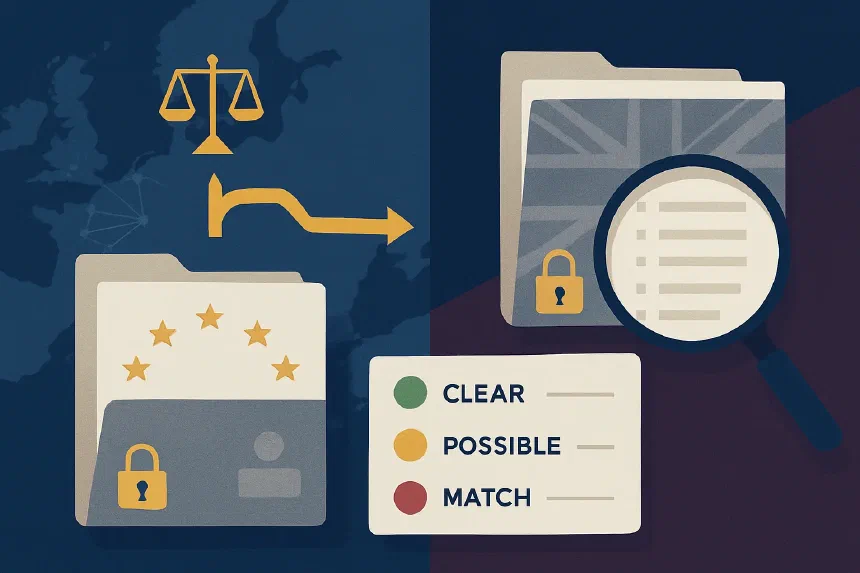
Since Brexit, the United Kingdom has maintained its own sanctions regime, entirely independent of the EU. The body responsible for its implementation is OFSI (Office of Financial Sanctions Implementation) at HM Treasury, which publishes the UK sanctions list for financial sanctions purposes.1 If you have counterparties in the UK, settle transactions in pounds sterling, or have a subsidiary across the Channel, that list ceased to be optional for you the moment the United Kingdom left the European Union.
Legal status as of: 2026-05-20.
TL;DR
- OFSI (Office of Financial Sanctions Implementation, HM Treasury) publishes the UK sanctions list — independent of the EU list since 1 January 2021.1
- The UK list is not identical to the EU list — since Brexit both lists evolve independently; the same person may be listed on one, both, or neither.
- A Polish company must check the UK list if it has counterparties in the United Kingdom, settles transactions in pounds sterling (GBP), or has a branch or subsidiary in the UK.
- Verification is carried out via the official OFSI search tool or by downloading the full file from gov.uk.1
- Breaching UK sanctions by an entity operating in the UK can result in a financial penalty imposed by HM Treasury — the level of penalties is governed by UK sanctions legislation.
- The EU list and the MSWiA (Polish Ministry of Interior and Administration) list continue to apply to your company independently of the UK list — you check them in parallel.
What OFSI and the UK sanctions list are
OFSI, or the Office of Financial Sanctions Implementation, is a unit within the UK’s treasury ministry — HM Treasury. Its purpose is to implement and enforce financial sanctions in the United Kingdom, including maintaining the register of entities subject to those measures.1
The official full name of the resource is the UK Consolidated List of Financial Sanctions Targets. You can find it at gov.uk/government/publications/financial-sanctions-consolidated-list-of-targets.1 The list contains individuals, companies, organisations, vessels, and aircraft subject to restrictive measures imposed by the UK government under successive statutory instruments made under UK sanctions legislation.
Each entry on the UK list contains similar information to its EU counterpart: the individual’s name or company name, aliases and former names, date and place of birth (for individuals), available identifiers, country of residence or registration, the basis for listing (the specific sanctions regime, e.g. Russia regulations, Belarus regulations, Iran regulations), and the date of designation. It is worth noting that Cyrillic transliterations in UK documents may differ from those used in EU documents — the same person may appear under different spelling variants of their name depending on the source.
OFSI regularly updates the list, publishes notices of changes, and issues derogatory licences for entities that need to carry out specific transactions with a person or company on the list (for example, to cover legal or humanitarian costs).
Brexit — why the UK now has its own sanctions regime
Before 31 January 2020, the United Kingdom applied EU sanctions directly — as an EU Member State, it was subject to Council Regulations that are directly applicable in all Member States.2 In practice, this meant the EU list was simultaneously the list in force in London.
That changed with the end of the Brexit transition period on 1 January 2021. From that date, the United Kingdom is no longer bound by Council Regulations of the EU. The UK government adopted its own legal framework for sanctions, which forms the basis for issuing domestic statutory instruments covering individual sanctions regimes.
The result is that since the start of 2021 two distinct sanctions regimes have operated in parallel: the EU regime — managed by the EU Council and the European Commission’s DG FISMA,3 and the UK regime — managed by OFSI at HM Treasury.1 Both regimes cover Russia, Belarus, Iran, and many other countries, but their scope of designated persons and entities has been diverging. The UK lists individuals the EU has not listed, and vice versa. From the perspective of a company conducting transactions on both sides of the Channel — these are two lists to check, not one.
The UK list vs the EU list — key differences since Brexit
Many business owners assume that because they check the EU list, they are automatically safe with respect to all sanctions regimes relating to the same group of countries. Since Brexit, that assumption is wrong for companies with connections to the United Kingdom.
The table below shows the main practical differences between the two lists.
| Feature | EU list (Consolidated List) | UK list (OFSI / HM Treasury) |
|---|---|---|
| Maintaining authority | DG FISMA, European Commission3 | OFSI, HM Treasury1 |
| Legal basis | Council Regulations of the EU (including 269/20144, 833/20145) | UK sanctions legislation + statutory instruments |
| Applies to companies in Poland | YES — directly2 | Indirectly — where there is a touchpoint with the UK |
| Scope of designation | Global, multi-regime; many packages (Russia, Belarus, Iran, DPRK, etc.) | Global, multi-regime; own packages since Brexit |
| Overlap with EU list | — | Significant, but incomplete — individuals and entities may appear on only one list |
| Updates | After each package and point changes6 | Regularly, on OFSI’s own schedule |
| Data source | finance.ec.europa.eu (EU Consolidated List)6 | gov.uk/government/publications/financial-sanctions-consolidated-list-of-targets1 |
| Ownership rule (50%) | YES — the prohibition covers companies controlled by a listed entity7 | YES — equivalent rule in UK legislation |
| Search tool | EU Sanctions Map8 / FSD search | OFSI search tool on gov.uk |
The key takeaway: since Brexit, the lists have diverged. You cannot treat the EU list as a full substitute for the UK list when transactions involve entities from the United Kingdom.
When a Polish company must check the UK list
Before moving on to the verification procedure, you need to answer one question: do you have anything to do with the United Kingdom? If the answer is “no” — the OFSI list is less relevant to you and you can focus on the EU list and the Polish MSWiA list.9 If the answer is “yes” — read on.
A Polish company should include the UK list in its sanction screening in the following situations:
You have counterparties, clients, or suppliers based in the United Kingdom. You sell products or services to them, buy from them, or lease them premises or equipment. In each of these cases you are exposed to the risk that the other party to the transaction is on the OFSI list, even if they are not on the EU list.
You settle transactions in pounds sterling (GBP). Just as USD settlements pass through correspondent banks in the US and are subject to OFAC controls, GBP settlements enter the UK banking system and may be blocked by an intermediary bank that applies the OFSI list.
You have a branch, representative office, or subsidiary in the UK. An entity operating on UK territory is directly subject to UK sanctions law and must conduct OFSI screening independently of its Polish parent company. The risk of a breach then concerns both the Polish parent and its UK subsidiary.
You have a contract containing a sanctions clause referencing UK law. In commercial agreements with British partners, a compliance with applicable sanctions clause is standard, and may expressly refer to UK legislation. Breaching such a clause constitutes a termination of the contract, irrespective of any regulatory liability.
If your company operates in sectors such as tourism and OTA (selling trips to or for UK nationals) or insurance (servicing policies for UK-based entities) — it is worth reviewing those relationships for touchpoints with the United Kingdom.
How to check a counterparty against the UK list — step by step
The procedure for verifying a counterparty against the OFSI list is similar to that used for the EU list, but relies on different tools and different data sources.
Go to the official OFSI page. The full list is available at gov.uk/government/publications/financial-sanctions-consolidated-list-of-targets.1 On the same page you will find links to the online search tool and to a downloadable file in CSV or Excel format.
Use the OFSI online search tool (for individual checks). Enter the person’s name or company name. Bear in mind that the search tool may not capture all transliteration variants — supplement your search manually with alternative spellings, particularly for Russian or Arabic names.
Download the CSV or Excel file (for larger numbers of entities). If you are screening your entire counterparty database, download the current file and compare it against your database using a matching algorithm. Plain Excel and simple filtering are not sufficient — you need matching that accounts for aliases, spelling variants, and dates of birth.
Check the file’s publication date. OFSI updates the list regularly. A file you downloaded a month ago may be out of date. Before each verification, ensure you are using the latest version.
Compare identifiers, not just the name. As with the EU list, a name alone is not sufficient. Compare the date of birth, passport number, or company identifier (Companies House registration number or equivalent from the country of registration), country of residence, and industry. You are verifying identity, not merely a match on a name.
Apply the ownership rule. The OFSI list — like the EU list7 — covers companies controlled by listed entities. Check whether the counterparty is owned or controlled by an individual or entity on the UK list.
Document the result. Record the date of verification, the version of the list used (the file’s publication date), the name and details of the entity checked, and the outcome — CLEAR, POSSIBLE, or MATCH. This record is your evidence of due diligence. The absence of documentation is equivalent to the absence of verification from the perspective of any potential inspection.
In the event of a hit — suspend the transaction and consult a lawyer. Do not make decisions unilaterally without a legal basis or an OFSI licence. If you have an entity in the UK, you are subject to UK procedures for reporting a hit to OFSI. If you are a Polish company with no UK presence — consult a lawyer as to what steps to take.
FAQ
Is OFSI the same as OFAC?
No. OFSI (Office of Financial Sanctions Implementation) is the UK authority at HM Treasury, responsible for financial sanctions in the United Kingdom.1 OFAC (Office of Foreign Assets Control) is the equivalent authority at the US Department of the Treasury, which maintains the SDN list.10 Both authorities maintain their own independent sanctions lists. A company may appear on the OFAC list but not on the OFSI list — and vice versa. For a Polish company, both authorities are relevant in different contexts: OFAC for transactions in USD or with US-connected entities, OFSI for transactions involving the United Kingdom.
Is the UK list a copy of the EU list after Brexit?
No. Although both lists share many common entries — particularly regarding Russia and Belarus — since 1 January 2021 each has evolved independently.1 The United Kingdom may list individuals that the EU has not listed, and vice versa. For this reason, the EU list must not be treated as a substitute for the UK list for companies with business relationships in the United Kingdom.
Where can I download the current UK list?
The current UK list is available at gov.uk/government/publications/financial-sanctions-consolidated-list-of-targets.1 You can download it in CSV or Excel format, and for individual checks use the OFSI search tool on the same page. The list is updated regularly — always check the file’s publication date before conducting a verification.
Does a Polish company with no connections to the UK need to check the OFSI list?
Generally no — the UK list is primarily relevant for companies with a touchpoint with the United Kingdom: counterparties, GBP-denominated transactions, or branches in the UK. If your company operates exclusively in the Polish and EU market, with no relationships involving British entities, the OFSI list is less relevant to you. You are still bound, however, by the EU list45 and the Polish MSWiA list.9 A full discussion of which lists apply to a Polish company can be found in the article EU, UN, OFAC and MSWiA sanctions lists — a guide.
Can a UK national be listed on the OFSI list?
Yes. The OFSI list may include both nationals and entities from third countries (Russia, Belarus, Iran, and others) and UK nationals or companies registered in the United Kingdom, provided they meet the designation criteria set out in the relevant sanctions regime.
How often is the UK list updated?
OFSI updates the list regularly, though without a predetermined weekly schedule. A practical rule is to download the current version of the file before each material counterparty verification, rather than relying on a copy from several weeks ago. If your company screens a large number of entities, it is worth considering automatic downloading of the list via an API or integrating with a system that does this for you.
Legal basis
- UK Consolidated List of Financial Sanctions Targets — OFSI, HM Treasury — gov.uk/government/publications/financial-sanctions-consolidated-list-of-targets
- Council Regulation (EU) No 269/2014 of 17 March 2014 concerning restrictive measures in respect of actions undermining or threatening the territorial integrity, sovereignty and independence of Ukraine — CELEX 32014R0269
- Council Regulation (EU) No 833/2014 of 31 July 2014 concerning restrictive measures in view of Russia’s actions destabilising the situation in Ukraine — CELEX 32014R0833
- Act of 13 April 2022 on specific solutions in the area of countering support for the aggression against Ukraine and serving the protection of national security (Journal of Laws 2022, item 835) — ISAP
- Polish sanctions list (MSWiA — Ministry of Interior and Administration) — gov.pl/web/mswia
- OFAC Specially Designated Nationals List (SDN) — ofac.treasury.gov
- EU Financial Sanctions Database (DG FISMA) — finance.ec.europa.eu
- EU Sanctions Map — sanctionsmap.eu
How Sanqto can help
Manually checking counterparties against several lists simultaneously — EU, MSWiA, OFSI, and OFAC — is time-consuming and error-prone, particularly as transaction volumes grow. Sanqto automates this process: the software runs on-premise within your company’s infrastructure, so your counterparty data never leaves your network. Verification returns a result in three states — MATCH, POSSIBLE, or CLEAR — enabling you to distinguish immediately between a confirmed hit and a suspicious case requiring manual review. The platform includes a package of implementation documents: a sanctions policy, a role-based procedure, and a hits register, all of which will prove useful in the event of an inspection.
For more on whether your company has a legal obligation to conduct screening at all, see the article does my company need to conduct sanction screening. If you operate in travel or act as an insurance intermediary and have clients in the United Kingdom — see our industry pages for travel agencies and insurance agents.
Footnotes
Information, not legal advice. This article is for informational and educational purposes only. It does not constitute legal advice. Legal status as of: 20 May 2026. Your company’s specific obligations depend on its business profile and require individual assessment — if in doubt, consult a lawyer or compliance adviser.
UK Consolidated List of Financial Sanctions Targets — OFSI (Office of Financial Sanctions Implementation), HM Treasury. Quote: “OFSI publishes the UK Sanctions List, which provides details of those designated under regulations made under the Sanctions Act.” URL: gov.uk/government/publications/financial-sanctions-consolidated-list-of-targets. Status: verified. ↩︎ ↩︎ ↩︎ ↩︎ ↩︎ ↩︎ ↩︎ ↩︎ ↩︎ ↩︎ ↩︎ ↩︎
An EU Regulation is directly applicable in every Member State without the need for transposition. Source: EUR-Lex — eur-lex.europa.eu/EN/legal-content/summary/regulation-eu-legal-act.html. Quote: “A regulation is binding in its entirety and directly applicable in all Member States.” Status: verified. ↩︎ ↩︎
DG FISMA (Directorate-General for Financial Stability, Financial Services and Capital Markets Union) — the European Commission body responsible for EU financial sanctions policy and maintenance of the Consolidated List. Source: finance.ec.europa.eu/eu-and-world/sanctions-restrictive-measures_en. Status: verified. ↩︎ ↩︎
Council Regulation (EU) No 269/2014 of 17 March 2014 concerning restrictive measures in respect of actions undermining or threatening the territorial integrity, sovereignty and independence of Ukraine. Primary source: Polish Parliament API — api.sejm.gov.pl; canonical text on EUR-Lex — CELEX 32014R0269. Status: verified. ↩︎ ↩︎
Council Regulation (EU) No 833/2014 of 31 July 2014 concerning restrictive measures in view of Russia’s actions destabilising the situation in Ukraine. Source: DG FISMA — finance.ec.europa.eu; EUR-Lex — CELEX 32014R0833. Status: verified. ↩︎ ↩︎
EU Financial Sanctions Database (FSD) maintained by DG FISMA, European Commission. Hub: finance.ec.europa.eu/eu-and-world/sanctions-restrictive-measures_en. Status: verified. ↩︎ ↩︎
Ownership/control rule — EU sanctions cover entities in which a listed person or entity holds at least 50% of proprietary rights or exercises control. Source: DG FISMA FAQ — finance.ec.europa.eu. Quote: “An entity is considered as ‘owned’ by a sanctioned person if the latter owns more than 50% of its proprietary rights.” Status: verified. ↩︎ ↩︎
EU Sanctions Map — interactive tool for browsing EU sanctions packages and targets. URL: sanctionsmap.eu. Status: verified. ↩︎
Polish sanctions list — Ministry of Interior and Administration (MSWiA). URL: gov.pl/web/mswia/lista-osob-i-podmiotow-objetych-sankcjami. Status: verified. ↩︎ ↩︎
OFAC Specially Designated Nationals and Blocked Persons List (SDN List) — U.S. Department of the Treasury. URL: ofac.treasury.gov. Status: verified. ↩︎