Sanctions Circumvention via Third Countries — How to Avoid Being Caught in the Net
Re-export through third countries is a sanctions trap. Learn to spot high-risk transactions and shield your business from unwitting EU sanctions circumvention.
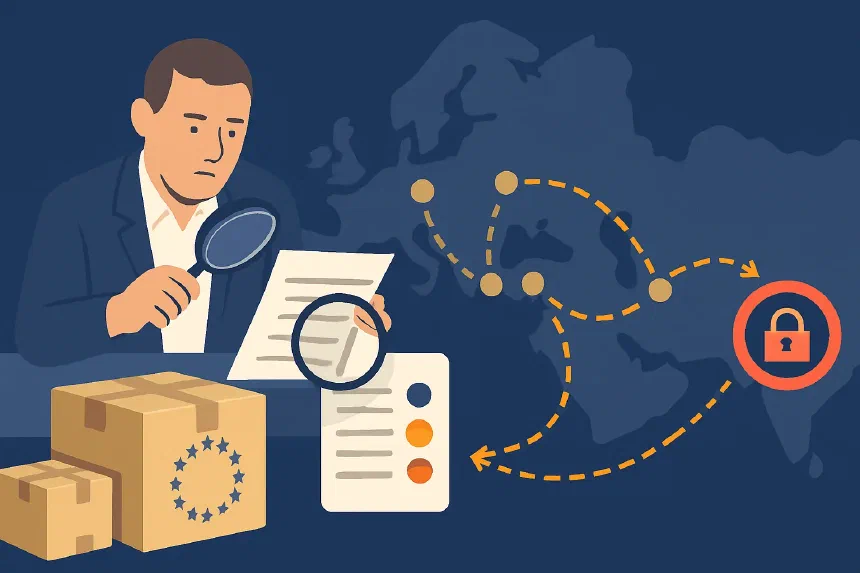
Your company does not trade directly with Russia — and that is precisely why you may be unaware of the risk. The mechanism of sanctions circumvention works like this: goods subject to an EU embargo reach Russia not directly, but through a chain of intermediaries in third countries. If your company is one of the links in that chain — even unknowingly — you are in breach of EU sanctions, with all the legal consequences that entails.
This article explains how this mechanism works, how to recognise it, and what to do to ensure your company does not become an inadvertent participant in the circumvention of sanctions against Russia.
Legal status as of: 2026-05-20.
TL;DR — the key points in 60 seconds
- The European Union has adopted 20 packages of sanctions against Russia to date, the latest on 23 April 20261 — the ban on exporting embargoed goods applies to all companies in the EU, regardless of sector or size. We cover the full timeline in our overview of EU sanctions packages against Russia.
- Circumvention means transferring a prohibited good to Russia via a third country — an intermediary in Kazakhstan, Armenia, the UAE, or another state re-exports the goods onward. Your company may be part of such a chain without knowing it.
- EU law prohibits not only direct breach of sanctions but also knowingly and intentionally participating in activities aimed at circumventing them.23
- Since the 11th package (23 June 2023), the “No re-export to Russia” clause has been mandatory — you must obtain a written commitment from the buyer in the third country that the goods will not reach Russia.45
- Red flags include: a new intermediary with no trading history, dual-use goods, an unusual logistics route, a discrepancy between the declared buyer and the actual end user.
- A breach — even an unintentional one — can result in a financial penalty of up to PLN 20,000,000 imposed by the Head of the National Revenue Administration (Szef Krajowej Administracji Skarbowej, KAS)6 and criminal liability under Directive (EU) 2024/1226.3
How sanctions are circumvented via third countries
EU sanctions against Russia prohibit the export of many categories of goods directly to Russia — the detailed catalogue is contained in Council Regulation (EU) No 833/2014 of 31 July 2014.2 The prohibitions apply to both direct and indirect sales. That second qualifier — “indirect” — is the critical one.
In practice, circumvention works as follows: an EU exporter sells goods to a company registered in a third country (which does not itself apply sanctions against Russia). That company re-exports the goods to Russia, often with minimal processing or through a transit customs structure. From the EU exporter’s perspective the transaction looks like an ordinary foreign sale — the goods officially go to a company outside the EU, and the invoice names a buyer in a third country.
The problem is that Regulation No 833/2014 prohibits the export of covered goods “directly or indirectly” to Russia or for the benefit of entities in Russia.2 This means that an EU company that sold goods to an intermediary, knowing or having reason to know that they would end up in Russia, is in breach of sanctions — regardless of the fact that it formally delivered the goods to a company in a third country. The mere insertion of an intermediary between the exporter and Russia does not disapply the prohibition.
The European Commission and the Council of the EU describe such intermediary countries as places “with continued and particularly high risk of circumvention”7 — though the available primary sources do not permit naming specific countries. In practice, these are states that border Russia or have traditionally close economic ties with it.
Why this is a risk for your company — unwitting participation is also a breach
Many Polish SMEs assume that sanctions concern only large corporations exporting military technology or companies that settle in roubles. This assumption is wrong. Regulation No 833/2014 applies directly to all entities on EU territory — it provides no minimum threshold and no exemption for small businesses.28
More importantly, Directive (EU) 2024/1226 of the European Parliament and of the Council of 24 April 20243 requires Member States to criminalise not only deliberate breaches of sanctions but also their facilitation. This means that if your company — even without any wrongful intent — supplied an embargoed good to an intermediary who then sent it to Russia, you may be held liable. The deadline for Member States to transpose this Directive expired on 20 May 20259 — Poland’s legislative process for implementing its provisions is currently under way.
The key question that a supervisory authority will ask is: did the company exercise due diligence? If you ignored obvious warning signs (a new intermediary, an unusual logistics route, dual-use goods), the argument “I didn’t know” is difficult to sustain. Supervisory authorities — in Poland primarily the Head of the National Revenue Administration (Szef KAS — Krajowej Administracji Skarbowej), which imposes financial penalties under Article 6(2) of the Act of 13 April 2022 on special solutions for countering support for aggression against Ukraine and for the protection of national security (Journal of Laws 2022, item 835)610 — examine the course of transactions and the verification documentation.
An EU exporter is, in effect, the first security filter in the entire supply chain. If that filter fails, liability rests with the company that allowed it to be bypassed.
EU anti-circumvention mechanisms — the “No re-export to Russia” clause
The European Union responded to the growing scale of sanctions circumvention with a specific legal instrument. As part of the 11th package of sanctions, adopted on 23 June 2023, provisions on the “No re-export to Russia” clause were introduced into Council Regulation (EU) No 833/2014, codified in Article 12g of that Regulation.45
What the “No re-export to Russia” clause requires
The clause obliges EU exporters who sell specified goods to third countries to obtain from the buyer a written commitment that the goods will not be re-exported to Russia or to entities in Russia. This applies principally to goods listed in the annexes to Regulation No 833/2014 — in particular dual-use goods and items on the so-called Common High Priority (CHP) list, i.e. a set of electronic and industrial components particularly sought after by the Russian defence industry.5
The clause must appear in the commercial contract or constitute a separate document signed by the recipient. Merely sending an e-mail informing the buyer of the re-export prohibition is insufficient — a formal, written contractual commitment is required. If the buyer refuses to sign it, treat this as a red flag and suspend the transaction.
What “dual-use” goods are — explained without jargon
The term dual-use refers to goods and technologies that have both civilian and military applications, or that can be used in the production of weapons. This is not limited to military equipment — it also covers electronic components, integrated circuits, engines, optical instruments, encryption software, specialised chemicals, and much more. The full list of such goods is contained in the annexes to Regulation No 833/2014 and is regularly expanded with each new package of sanctions.11 If your company produces or distributes anything in this category, the risk of sanctions circumvention via your distribution network is particularly high.
To check whether your specific product is subject to a prohibition, use the European Commission’s TARIC database — the search tool operates on the basis of the CN code of the good and incorporates sanctions on an ongoing basis.12
Red flags — how to recognise a high-risk transaction
No single signal definitively indicates an attempt to circumvent sanctions — it is usually a combination of several factors. Below is a list of circumstances that should trigger an enhanced verification procedure before you sign a contract or dispatch goods.
A new intermediary with no trading history. A company that suddenly appears as the buyer of dual-use goods, has no website, whose registered address is a virtual office, and whose share capital is nominal — this combination of characteristics is typical of a shell company created solely for the purpose of re-export.
Goods whose stated purpose does not match the buyer’s profile. A company importing advanced electronic components or specialised machinery into a third country, without being a manufacturer or dealer in that field, has no obvious business reason to acquire them. If you cannot answer the question “why does this company need this product”, you should ask the buyer directly.
An unusual or multi-stage logistics route. Goods travelling from Poland to a company in country A, which according to the documentation are then to be “transported” to country B before final delivery — particularly if country B borders Russia — is a signal that requires explanation.
A discrepancy between the declared buyer and the stated end user. If the buyer provides details that differ from those of the actual recipient, or if the transport documents indicate a location that does not match the delivery address in the contract, a question arises as to the true destination of the goods.
Payment by a third party or in an unexpected currency. When entity A places an order but entity B makes the payment — and there is no clear explanation for this structure — it is worth asking why.
No interest in warranty or after-sales service terms. A buyer of equipment who asks no questions about warranty conditions, repairs, or after-sales service is probably not planning to use the goods long-term at the stated delivery location.
The European Commission officially identifies third countries with an elevated risk of circumvention as places through which such transactions are particularly frequently routed.7 If your counterparty is registered in one of these countries, each of the above red flags should result in the transaction being suspended until the concerns have been clarified.
How to protect your company — due diligence and contractual clauses
What due diligence means — without jargon
Due diligence simply means systematically verifying a counterparty before concluding a transaction. Just as you check a used car’s service history and VIN before buying it, you should check who the buyer is, what their business does, and why they need your product before selling a dual-use good. In the context of sanctions, due diligence is not optional — it is your line of defence if something goes wrong.
Step by step — how to carry out verification
1. Identify whether your goods are subject to the embargo. Check your product’s CN code in the European Commission’s TARIC database12 and compare it against the annexes to Regulation No 833/2014.11 If the code matches the list, you are dealing with a high-risk good and every sale to a third country requires heightened diligence.
2. Verify the buyer’s identity. Check whether the buying company appears on the EU Consolidated Financial Sanctions List13 and on the Polish list maintained by the minister responsible for internal affairs (MSWiA — Ministerstwo Spraw Wewnętrznych i Administracji).1415 Also check whether it is controlled by a sanctioned entity — under the ownership rule, an entity is treated as sanctioned if a sanctioned person holds more than 50% of its ownership rights.16
3. Identify the actual end user. Ask directly: who will actually use the goods and for what purpose? If the buyer refuses to provide this information or provides information inconsistent with the transaction profile, suspend the sale. Also check the counterparty’s ownership structure — this is described in detail in the article on the 50% ownership rule in EU sanctions.
4. Insert the “No re-export to Russia” clause in the contract. This is a legal requirement under Article 12g of Regulation No 833/2014 for specified goods.45 The clause should be worded explicitly: the buyer undertakes that the goods will not reach Russia or Russian entities, and that a breach of this undertaking entitles your company to terminate the contract immediately.
5. Obtain a written End-User Certificate (EUC). For high-risk goods, standard practice is to request a document in which the buyer confirms the identity and location of the end user. If the buyer claims the goods are for their own production facility, ask for confirmation of the facility’s address and verify that this is plausible.
6. Document the entire verification procedure. Retain copies of sanctions list searches with the date and time, correspondence with the counterparty, signed clauses, and end-user declarations. In the event of an inspection, it is documentation — not declarations — that determines the outcome of proceedings. The Act of 1 March 2018 on countering money laundering and terrorist financing specifies a five-year retention period for documentation for obliged entities within the meaning of that Act17 — it is prudent to apply an analogous approach to sanctions verification documentation.
7. Implement an internal red-flag review procedure. Before any high-risk transaction is approved, it should pass through a review by at least one person responsible for compliance — even if that person is the business owner. A paper trail of that decision is essential.
Penalties for participation in sanctions circumvention
Participation in sanctions circumvention — even unintentional — is subject to the same penalties as a direct breach of the embargo. Below is a summary of the main consequences.
| Type of liability | Legal basis | Maximum penalty |
|---|---|---|
| Financial (administrative) penalty | Article 6(2) of the Act of 13.04.20226 | Up to PLN 20,000,000 |
| Criminal liability (deliberate breach) | Directive (EU) 2024/1226, Article 5(3)(b)18 | Up to 5 years’ imprisonment |
| Enforcement authority in Poland | Article 6(2) of the Act of 13.04.202210 | Head of the National Revenue Administration (Szef KAS) |
The penalty of up to five years’ imprisonment provided for in Directive (EU) 2024/1226 applies to breaches involving funds or economic resources with a value of at least EUR 100,000.18 The deadline for Member States to transpose this Directive expired on 20 May 20259 — Poland’s legislative process for implementing its provisions in national law is currently under way.
It is also worth noting that Polish companies which conduct transactions in US dollars or have connections with entities from the United States may be subject to OFAC (Office of Foreign Assets Control, U.S. Department of the Treasury) sanctions.19 OFAC’s jurisdiction is broad and covers, amongst other things, transactions settled in USD — even where the company is registered outside the United States.
FAQ — frequently asked questions
If the buyer in the third country assures me that the goods will not reach Russia, am I protected?
A verbal assurance or a simple e-mail is insufficient. The “No re-export to Russia” clause must be a formalised contractual commitment — written into the sale contract or constituting a separate signed document. This is a requirement under Article 12g of Regulation No 833/2014.45 Furthermore, merely holding the clause does not relieve you of your verification obligation — if you had reason to suspect re-export to Russia, the clause does not act as a shield.
Can my goods be subject to a prohibition even if I do not produce anything military?
Yes. The dual-use category is very broad and covers many apparently civilian products — from electronic components, through specialised software, to certain chemicals and materials. To check your product, look up its CN code in the TARIC database12 and compare it against the annexes to Regulation No 833/2014.11
What are the consequences of unwitting participation in a sanctions circumvention chain?
Administrative liability (a financial penalty of up to PLN 20,000,0006) can arise even without deliberate intent — the key question is whether you exercised due diligence. Criminal liability under Directive (EU) 2024/1226 requires intent.3 Verification documentation (who checked what, when, and what decisions were taken) is the primary instrument of defence.
Should I verify a counterparty before every transaction, or is a one-off check sufficient?
The EU sanctions list is updated with every new package. The initial steps — checking the identity and ownership structure of the buying company — can be carried out once when establishing the relationship, but verification against sanctions lists should be repeated before every significant transaction and whenever there are changes in the counterparty’s ownership structure or any doubts arise. Entries on the EU Consolidated List exceeded 2,500 individual listings after the 18th package of sanctions20 — and the number continues to grow.
What documents should I retain as evidence of due diligence?
The minimum set comprises: a print-out or screenshot of the search on the EU Consolidated List with the date and time of the search, the signed “No re-export” clause or end-user declaration, a copy of the buying company’s registration documents, and correspondence relating to questions about the purpose of the purchase. Documentation should be retained for at least five years — analogous to the retention period under Article 49 of the Act of 1 March 2018 on countering money laundering.17
Can a company from a third country that bought goods from me appear on the EU sanctions list?
The EU Consolidated List (CELEX 32014R026921) covers natural and legal persons listed by the Council of the EU — regardless of where they are registered. An entity registered in a third country may appear on that list. If an entity is more than 50% controlled by a person or company subject to sanctions, it is itself subject to the prohibitions — even without a separate listing.16
How Sanqto helps companies reduce the risk of sanctions circumvention
Verifying a counterparty against multiple sanctions lists simultaneously — the EU list, the Polish MSWiA list, the UN list — is a task that, when done manually, takes time and carries the risk of missing an entry. Sanqto automates this process: software installed within your company’s own infrastructure (on-premise, data never leaves your network) verifies counterparties on an ongoing basis and returns one of three results — MATCH, POSSIBLE, or CLEAR. It helps reduce the risk of inadvertently overlooking entries on sanctions lists and records every verification with a date and timestamp.
If your company operates in real estate, tourism, or any other sector subject to sanctions obligations, find out what counterparty verification for sanctions looks like in practice.
Learn more about which companies are subject to the obligation to conduct sanctions screening in the article Does my company have to carry out sanctions screening?
Legal basis
- Council Regulation (EU) No 833/2014 of 31 July 2014 concerning restrictive measures in view of Russia’s actions destabilising the situation in Ukraine — CELEX 32014R0833
- Council Regulation (EU) No 269/2014 of 17 March 2014 concerning restrictive measures in respect of actions undermining or threatening the territorial integrity, sovereignty and independence of Ukraine — CELEX 32014R0269
- Directive of the European Parliament and of the Council (EU) 2024/1226 of 24 April 2024 on the definition of criminal offences and penalties for the violation of Union restrictive measures — CELEX 32024L1226
- Act of 13 April 2022 on special solutions for countering support for aggression against Ukraine and for the protection of national security (Journal of Laws 2022, item 835) — eli.gov.pl
- Act of 1 March 2018 on countering money laundering and terrorist financing — eli.gov.pl
- DG FISMA FAQ — “No re-export to Russia” clause (Article 12g of Regulation No 833/2014) — finance.ec.europa.eu
- EU Consolidated Financial Sanctions List — webgate.ec.europa.eu/fsd
- Polish sanctions list (MSWiA) — gov.pl/web/mswia
- TARIC database — ec.europa.eu/taxation_customs/dds2/taric
- EU sanctions against Russia — overview of packages, DG FISMA — finance.ec.europa.eu
Related articles
- What sanctions apply to Russia? — overview of all three sanctions regimes
- Embargo on Russia — a practical guide — which goods are prohibited and how to check a CN code in TARIC
- Does my company have to carry out sanctions screening?
Information, not legal advice. This article is for informational and educational purposes only. It does not constitute legal advice. Legal status as of: 20 May 2026. Your company’s specific obligations depend on its business profile and require individual assessment — if in doubt, consult a lawyer or compliance adviser.
Sanctions adopted following Russia’s military aggression against Ukraine — DG FISMA, page updated 23 April 2026, finance.ec.europa.eu ↩︎
Council Regulation (EU) No 833/2014 of 31 July 2014, Article 2(1) — prohibition on the sale, supply, transfer or export of dual-use goods and technology directly or indirectly — CELEX 32014R0833 ↩︎ ↩︎ ↩︎ ↩︎
Directive of the European Parliament and of the Council (EU) 2024/1226 of 24 April 2024 — CELEX 32024L1226 ↩︎ ↩︎ ↩︎ ↩︎
DG FISMA FAQ — “No re-export to Russia” clause, concerning Article 12g of Council Regulation (EU) No 833/2014, of 18 December 2024 — finance.ec.europa.eu; clause introduced by the 11th package of sanctions, 23 June 2023 ↩︎ ↩︎ ↩︎ ↩︎
Article 12g of Council Regulation (EU) No 833/2014 — the legal basis for the “No re-export to Russia” clause — CELEX 32014R0833 ↩︎ ↩︎ ↩︎ ↩︎ ↩︎
Act of 13 April 2022 on special solutions for countering support for aggression against Ukraine (Journal of Laws 2022, item 835), Article 6(2) — “The financial penalty shall be imposed by the Head of the National Revenue Administration (Szef Krajowej Administracji Skarbowej), by way of a decision, in an amount of up to PLN 20,000,000” — eli.gov.pl ↩︎ ↩︎ ↩︎ ↩︎
The European Commission and the Council of the EU identify “third countries with continued and particularly high risk of circumvention” as a priority for anti-circumvention instruments — finance.ec.europa.eu ↩︎ ↩︎
An EU Regulation is binding in its entirety and directly applicable in all Member States (Article 288 TFEU) — eur-lex.europa.eu ↩︎
Directive (EU) 2024/1226, Article 20(1) — implementation deadline: 20 May 2025 — CELEX 32024L1226 ↩︎ ↩︎
Act of 13 April 2022 (Journal of Laws 2022, item 835), Article 6(2) — the Head of KAS as the authority imposing financial penalties — eli.gov.pl ↩︎ ↩︎
Council Regulation (EU) No 833/2014, Annex II — list of technologies and goods subject to prohibition, containing CN codes — CELEX 32014R0833 ↩︎ ↩︎ ↩︎
TARIC Consultation — European Commission Taxation and Customs, last TARIC update: 19-05-2026 — ec.europa.eu/taxation_customs/dds2/taric ↩︎ ↩︎ ↩︎
EU Consolidated Financial Sanctions List — webgate.ec.europa.eu/fsd; DG FISMA page with links to the lists — finance.ec.europa.eu ↩︎
List of persons and entities subject to sanctions — Ministry of Internal Affairs and Administration (MSWiA) — gov.pl/web/mswia ↩︎
Act of 13 April 2022 (Journal of Laws 2022, item 835), Article 2(1) and Article 3(1) — list maintained by the minister responsible for internal affairs — eli.gov.pl ↩︎
EU FAQ — ownership rule: an entity is treated as sanctioned if a sanctioned person holds more than 50% of its ownership rights — finance.ec.europa.eu ↩︎ ↩︎
Act of 1 March 2018 on countering money laundering and terrorist financing, Article 49 — five-year retention period for documentation for obliged entities — eli.gov.pl ↩︎ ↩︎
Directive (EU) 2024/1226, Article 5(3)(b) — maximum term of imprisonment of at least 5 years where the breach involves funds or economic resources with a value of at least EUR 100,000 — CELEX 32024L1226 ↩︎ ↩︎
Office of Foreign Assets Control (OFAC), U.S. Department of the Treasury — Ukraine-/Russia-related sanctions programme — ofac.treasury.gov ↩︎
EU adopts 18th package of sanctions against Russia — DG FISMA, July 2025 — “the number of individual listings exceeds 2500” — finance.ec.europa.eu ↩︎
Council Regulation (EU) No 269/2014 of 17 March 2014, Article 2(1)–(2) — CELEX 32014R0269 ↩︎