The 50% Ownership Rule in EU Sanctions — What You Need to Know About Indirect Control
EU sanctions cover companies controlled by listed persons, even if unlisted themselves. We explain the over-50% threshold, control, UBO, and holding structures.
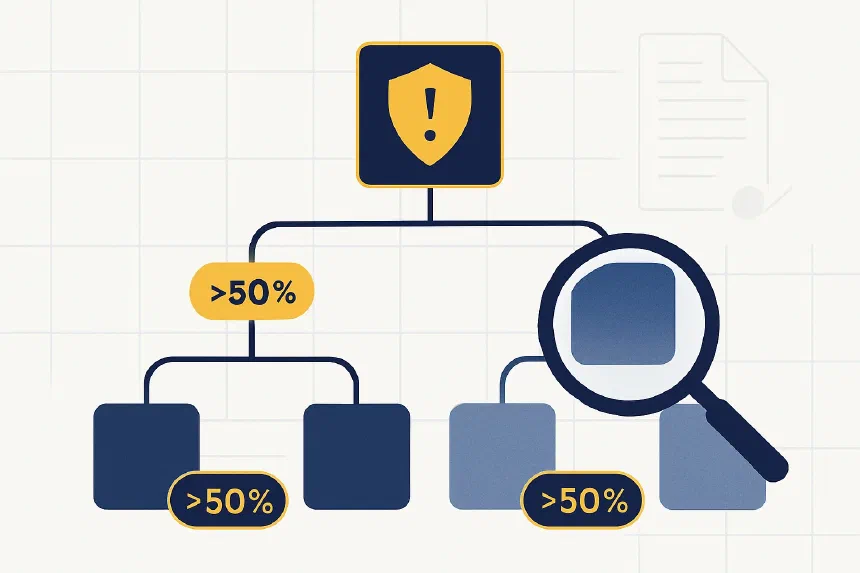
Your counterparty does not appear on any sanctions list — but its owner is a person subject to EU sanctions. Can you safely sign a contract with them? The answer is no. Council Regulation (EU) No 269/2014 of 17 March 20141 covers not only entities listed directly, but also those in which a listed person or entity holds more than 50% of the ownership rights or over which they exercise control. This is the ownership and control rule — and it is one of the most commonly overlooked pitfalls in day-to-day counterparty screening.
Legal status as of: 2026-05-20.
TL;DR — key facts in 90 seconds
- EU sanctions operate “through the owner”. A company that does not itself appear on any list is nonetheless subject to restrictive measures if a sanctioned person or entity holds more than 50% of its ownership rights or exercises control over it.2
- The threshold is “more than 50%”, not “at least 50%”. Exactly half the shares (50%) does not trigger the rule — it is only triggered by one share above that half.
- Control is not just about shareholding. You can exercise control with less than 50% of the shares — for example, through the right to appoint the majority of the board. Such a company is also subject to sanctions.
- Stakes held by several listed persons are aggregated. If three listed persons each hold 20% in the same company, the combined threshold (60%) is exceeded.
- Holding structures are the preferred method of evasion — EU sanctions pierce through successive layers of companies.
- A breach can result in a fine of up to PLN 20 million under Article 6(2) of the Act of 13 April 20223 — regardless of whether your counterparty itself appeared on any list.
- How to check in practice? The National Court Register (KRS), the Central Register of Beneficial Owners (CRBR) and their foreign equivalents — and for complex structures: professional screening tools.
What the ownership and control rule involves
EU sanctions legislation — in particular Council Regulation (EU) No 269/20141 and Council Regulation (EU) No 833/2014 of 31 July 20144 — contains the concept of entities “owned or controlled” by listed persons and entities. This rule flows directly from the wording of those regulations and is clarified by the guidelines of DG FISMA (the Directorate-General for Financial Stability, Financial Services and Capital Markets Union5).
EU regulations are directly applicable in all Member States without the need for transposition into national law.6 This means that your company must apply the ownership rule today, regardless of whether you learned of it from Polish legislation or from an EU regulation.
The logic of the rule is straightforward: if sanctions applied only to entities explicitly listed, circumventing them would be trivial. It would suffice to transfer assets to a controlled subsidiary. EU sanctions law closed that loophole — the prohibitions and the obligation to freeze assets extend across the entire chain of ownership and control. In practice, this means that before you enter into a contract with a new counterparty, you must not only check its name against the lists, but also verify who stands behind it. If you are unsure whether this obligation applies to your company, start with the article does my company need to conduct sanction screening.
The “more than 50%” threshold — and why exactly 50% is not enough
DG FISMA specifies that an entity is considered to be “owned” by a sanctioned person if that person holds more than 50% of its proprietary rights.2 The use of the phrase “more than 50%” is deliberate and carries a specific legal meaning.
Exactly 50% of shares does not automatically trigger the ownership rule — because a holder of half the shares cannot unilaterally make decisions in every company. It is only when that threshold is crossed — by one share, by one percentage point — that the holder gains a dominant position, and the company therefore becomes subject to restrictive measures.
For your company, this distinction is practically significant. If you are examining the ownership structure of a counterparty and see that a sanctioned person holds exactly 50% of the shares, the “ownership” threshold is formally not crossed — but do not stop your verification at that point. You must look deeper and assess whether that person exercises control by other means (discussed in the next section). The line between 50% and 50.01% is fine, but legally fundamental.
It is also worth noting that the threshold is calculated by reference to proprietary rights, not solely to voting rights at a general meeting. In some structures these rights may be separated — so analysing votes alone can lead to incorrect conclusions.
Control without a majority stake — when less than 50% still means sanctions apply
Holding less than 50% of the shares does not rule out a situation in which a given person or entity exercises control over a company. EU law recognises various mechanisms of control — and each of them can result in the company being subject to restrictive measures.
Practical examples of control without a majority stake include:
- The right to appoint or remove the majority of the management board. Even if someone holds only 30% of the shares but the articles of association grant them the right to nominate the chief executive and the majority of the supervisory board, they exercise effective control over the entity.
- Veto rights over strategic decisions. Shareholders’ agreements often grant minority shareholders the right to block key operational decisions — which de facto means control.
- Operational management without formal titles. A person on a sanctions list may not be formally registered anywhere but may effectively direct the company’s operations — for example, by issuing binding instructions to management.
Verifying this kind of control is considerably more difficult than checking the percentage of shares in the KRS (Krajowy Rejestr Sądowy — the Polish National Court Register). It requires analysing the articles of association, shareholders’ agreements, and sometimes the actual decision-making patterns. Therefore, for counterparties with elevated risk — for example companies registered in jurisdictions known for opacity or with shareholders from countries subject to a sanctions regime — it is worth spending more time on this step.
Aggregation of stakes held by several listed persons
The ownership rule applies not only when a single sanctioned person holds more than 50% of the shares. If several persons or entities on a sanctions list together exceed the 50% threshold, the company is equally subject to restrictive measures.2
Consider a straightforward scenario: company XYZ has three shareholders — Ivanov (25%), Petrova (20%), and Sidorenko (20%). None of them individually exceeds the 50% threshold. But if all three appear on the EU sanctions list, their combined stake is 65% — and the ownership rule applies to company XYZ in full.
This aggregation principle means that the list of questions to ask when verifying a counterparty must be longer than simply “is any shareholder on the list and does that shareholder hold more than 50%?”. You must trace all shareholders and aggregate the stakes of those that appear on sanctions lists — the EU list,7 the MSWiA list (Minister of Internal Affairs and Administration — Poland’s national sanctions list),8 and for contracts with a global dimension, the OFAC SDN list9 and the UN list.10
In practice, such a case is difficult to detect manually. Where there are several foreign shareholders whose interconnections are not obvious, the risk of missing the aggregation is real. This is one of the main arguments in favour of tools that automatically map the ownership structure and cross-reference it with multiple lists simultaneously.
Beneficial owner (UBO) and holding structures
UBO (Ultimate Beneficial Owner) is the natural person who ultimately owns or controls an entity — even if there are several layers of companies between them and that entity. The concept of the beneficial owner exists in both anti-money-laundering law — the Act of 1 March 2018 on counteracting money laundering and terrorist financing11 — and in the sanctions context, where it is the key to understanding the ownership rule.
Holding structures are the most commonly used method of concealing the true owner. The pattern is as follows: a person on a sanctions list establishes company A in Cyprus, which holds 60% of the shares in company B in Luxembourg, which in turn is a 70% shareholder in your Polish counterparty. None of those companies appears on a sanctions list. But the ownership rule “pierces” through successive layers — because the sanctioned person indirectly holds a sufficient portion of the proprietary rights to bring the entire structure within the scope of restrictive measures.
This is not an abstract scenario — structures of this kind genuinely existed before 2022, and some continue to exist. Counterparty verification in the sanctions context therefore cannot end with checking the counterparty’s name against a list. It must cover at least:
- Checking the counterparty’s direct shareholders.
- Identifying beneficial owners (UBOs) from available registers.
- Assessing whether any UBOs or indirect shareholders appear on sanctions lists.
The Act of 1 March 201811 imposed on certain Polish entities an obligation to disclose their beneficial owners in the Central Register of Beneficial Owners (CRBR — Centralny Rejestr Beneficjentów Rzeczywistych). This is a useful tool — but only for companies with a registered seat in Poland. For foreign counterparties, you must turn to the CRBR equivalents in other EU countries or to commercial databases.
How to check a counterparty’s ownership structure in practice
Verification against the ownership and control rule requires several steps that differ from the standard “enter the name on a list and check the result”. Here is a concrete process:
Identify the counterparty’s direct shareholders. For Polish companies: an extract from the KRS (National Court Register) or, for sole traders, information from the CEIDG (Central Register and Information on Economic Activity). KRS data is available online and free of charge at rejestr.io or directly through the KRS portal. Check current data — do not rely on old documents, as ownership structures change.
Check the beneficial owners (UBOs). For Polish companies: the Central Register of Beneficial Owners (crbr.podatki.gov.pl). For foreign entities: national equivalents (e.g. Companies House in the UK, Handelsregister in Germany, RCS in Luxembourg) or commercial databases aggregating data from multiple registers.
Verify every identified person and entity against sanctions lists. Cross-reference the names of shareholders and UBOs against:
Apply the aggregation rule. Add up the stakes of all persons and entities that have appeared on sanctions lists. If they collectively exceed 50%, the contract is blocked.
Assess non-shareholding control mechanisms. Review available information about shareholders’ agreements, rights to appoint the board, and the actual exercise of management, particularly where any person connected with the counterparty raised concerns in the previous steps.
Document the verification. Record the date of the check, which lists were used, what input data was used (full name, date of birth, identification number), the result of each check, and the final decision. In the event of an inspection, the absence of documentation is treated as the absence of verification.
For companies that verify many counterparties on a regular basis, manually working through these steps for each entity is impractical. Automated sanction screening tools allow this process to be conducted systematically — with automatic mapping of the ownership structure and cross-referencing against up-to-date lists. This reduces verification time and lowers the risk of human error when aggregating stakes.
FAQ — frequently asked questions about the ownership rule
Does the ownership rule apply only to sanctions related to Russia and Ukraine?
No. The ownership and control rule is built into EU restrictive measures legislation in general — it applies to both sanctions connected with the aggression against Ukraine (Reg. 269/20141, Reg. 833/20144) and to sanctions against Belarus (Council Regulation (EC) No 765/2006 of 18 May 200613) as well as to other sanctions regimes. The EU Consolidated List maintained by DG FISMA5 covers entities from all regimes.
What happens to a transaction if it later emerges that the counterparty was subject to the ownership rule?
A transaction concluded with an entity covered by sanctions — even indirectly through the ownership rule — constitutes a breach of the regulations. The Act of 13 April 202214 provides for liability for breach of the obligation to freeze funds and for the prohibition on making funds available to sanctioned entities. The authority empowered to impose penalties — the Head of the National Revenue Administration (KAS — Krajowa Administracja Skarbowa)15 — may impose a fine of up to PLN 20 million.3 The full catalogue of consequences is described in the article on penalties for breaching sanctions. The fact that you were unaware of the counterparty’s indirect connection with a sanctioned person does not automatically relieve you of liability — it may mitigate it, but you must demonstrate that due diligence was exercised.
Do I need to check the ownership rule before every transaction?
In principle, yes — or at the very least regularly, with a mechanism for checking whether, since the last verification, there have been any changes to the lists or to the counterparty’s ownership structure. EU sanctions lists are updated regularly,7 and a change in the counterparty’s ownership structure may occur without your knowledge. Good practice is to verify when a relationship is established and then monitor alerts for changes to the lists.
What does a “POSSIBLE” result mean when verifying a counterparty?
In sanction screening tools, a POSSIBLE result (as distinct from MATCH and CLEAR) means that the counterparty’s data resembles the data of a person or entity on a list but is not identical — for example, a difference in the spelling of a name or a similar date of birth. In the context of the ownership rule, a POSSIBLE result for any shareholder requires deeper analysis before deciding whether to proceed with the transaction. It must not be automatically treated as CLEAR.
How deeply do I need to look through holding layers?
EU law does not specify an explicit number of levels to be analysed — it refers to entities “owned or controlled”. In practice, the line of expectations adopted by supervisory authorities points towards verification of all layers through which a sanctioned person could exercise control. For complex multi-level structures (e.g. three or four layers of offshore companies), heightened vigilance is required. The higher the risk of the transaction, the deeper the analysis expected.
Does the Polish CRBR show all owners of foreign shareholder companies?
No — the CRBR covers only entities obliged to register in Poland under the Act of 1 March 2018.11 If the direct shareholder of your counterparty is a company registered abroad, you must obtain data from the register in the country of its registered seat or from commercial databases. The CRBR is a useful starting point but is insufficient for foreign ownership structures.
How Sanqto can help
Sanqto is sanction screening software installed within the client’s own network (on-premise model) — the data of verified counterparties never leaves your infrastructure. The system applies a three-state result model: MATCH, POSSIBLE, and CLEAR, and verification takes less than 30 ms even for complex queries. If you run a real estate agency, an insurance company, or another non-financial entity with an obligation to verify counterparties, Sanqto helps automate the process — including checking ownership structures and flagging cases that require analysis under the ownership rule. More about what the full verification process looks like can be found in the article Counterparty verification for sanctions — a complete guide.
Legal basis
The following acts form the legal basis for the principles described in this article. All EU regulations are directly applicable in Poland without the need for transposition.6
- Council Regulation (EU) No 269/2014 of 17 March 2014 concerning restrictive measures in respect of actions undermining or threatening the territorial integrity, sovereignty and independence of Ukraine — CELEX 32014R0269
- Council Regulation (EU) No 833/2014 of 31 July 2014 concerning restrictive measures in view of Russia’s actions destabilising the situation in Ukraine — CELEX 32014R0833
- Council Regulation (EC) No 765/2006 of 18 May 2006 concerning restrictive measures in view of the situation in Belarus — CELEX 32006R0765
- Directive (EU) 2024/1226 of the European Parliament and of the Council of 24 April 2024 on the definition of criminal offences and penalties for the violation of Union restrictive measures — CELEX 32024L1226
- Act of 13 April 2022 on special solutions to counter support for aggression against Ukraine and to protect national security (Dz.U. 2022 item 835) — ISAP
- Act of 1 March 2018 on counteracting money laundering and terrorist financing (Dz.U. 2018 item 723) — UBO/beneficial owner context — ISAP
- EU Consolidated Sanctions List (FSD) — DG FISMA, European Commission — finance.ec.europa.eu
- EU Sanctions Map — interactive tool for reviewing EU sanctions packages and their targets — sanctionsmap.eu
- Polish Sanctions List — Minister of Internal Affairs and Administration (MSWiA) — gov.pl/web/mswia
- SDN List — OFAC (U.S. Department of the Treasury, Office of Foreign Assets Control) — ofac.treasury.gov
- UN Security Council Consolidated List — un.org
Footnotes
Information, not legal advice. This article is for informational and educational purposes only. It does not constitute legal advice. Legal status as of: 20 May 2026. The specific obligations of your company depend on your business profile and require individual assessment — if in doubt, consult a lawyer or compliance adviser.
Council Regulation (EU) No 269/2014 of 17 March 2014 concerning restrictive measures in respect of actions undermining or threatening the territorial integrity, sovereignty and independence of Ukraine — CELEX 32014R0269; confirmed via Sejm API: api.sejm.gov.pl/eli/acts/DU/2022/835 ↩︎ ↩︎ ↩︎
DG FISMA FAQ — ownership and control rule: “An entity is considered as ‘owned’ by a sanctioned person if the latter owns more than 50% of its proprietary rights.” — finance.ec.europa.eu ↩︎ ↩︎ ↩︎
Article 6(2) of the Act of 13 April 2022 — financial penalty of up to PLN 20,000,000 imposed by the Head of the National Revenue Administration (KAS) — api.sejm.gov.pl/eli/acts/DU/2022/835 ↩︎ ↩︎
Council Regulation (EU) No 833/2014 of 31 July 2014 concerning restrictive measures in view of Russia’s actions destabilising the situation in Ukraine — CELEX 32014R0833; source: DG FISMA, finance.ec.europa.eu ↩︎ ↩︎
DG FISMA (Directorate-General for Financial Stability, Financial Services and Capital Markets Union) — the European Commission body responsible for EU financial sanctions policy — finance.ec.europa.eu/eu-and-world/sanctions-restrictive-measures_en ↩︎ ↩︎
EU regulations are binding in their entirety and directly applicable in all Member States without the need for transposition — EUR-Lex, summary of EU law: eur-lex.europa.eu/EN/legal-content/summary/regulation-eu-legal-act.html ↩︎ ↩︎
EU Consolidated Sanctions List (FSD) — DG FISMA, European Commission — finance.ec.europa.eu/eu-and-world/sanctions-restrictive-measures_en; FSD endpoint: webgate.ec.europa.eu/fsd/fsf ↩︎ ↩︎ ↩︎
List of persons and entities subject to sanctions — Minister of Internal Affairs and Administration (MSWiA) — gov.pl/web/mswia/lista-osob-i-podmiotow-objetych-sankcjami ↩︎ ↩︎
OFAC Specially Designated Nationals and Blocked Persons List (SDN) — U.S. Department of the Treasury, Office of Foreign Assets Control — ofac.treasury.gov ↩︎ ↩︎
UN Security Council Consolidated List — list of persons and entities subject to measures imposed by the UN Security Council — un.org/securitycouncil/content/un-sc-consolidated-list ↩︎ ↩︎
Act of 1 March 2018 on counteracting money laundering and terrorist financing (Dz.U. 2018 item 723) — ISAP ↩︎ ↩︎ ↩︎
EU Sanctions Map — interactive tool for reviewing EU sanctions packages and their targets — sanctionsmap.eu ↩︎
Council Regulation (EC) No 765/2006 of 18 May 2006 concerning restrictive measures in view of the situation in Belarus — CELEX 32006R0765 ↩︎
Act of 13 April 2022 on special solutions to counter support for aggression against Ukraine and to protect national security (Dz.U. 2022 item 835) — ISAP; ELI API: api.sejm.gov.pl/eli/acts/DU/2022/835 ↩︎
Article 6(2) of the Act of 13 April 2022 — Head of the National Revenue Administration (KAS — Krajowa Administracja Skarbowa) as the authority imposing financial penalties — api.sejm.gov.pl/eli/acts/DU/2022/835 ↩︎