EU Sanctions and the Sole Proprietorship — Does a Small Business Have to Check Too?
Running a sole proprietorship or micro-business? EU regulations set no size threshold — find out when sanctions apply and how to comply with minimal effort.
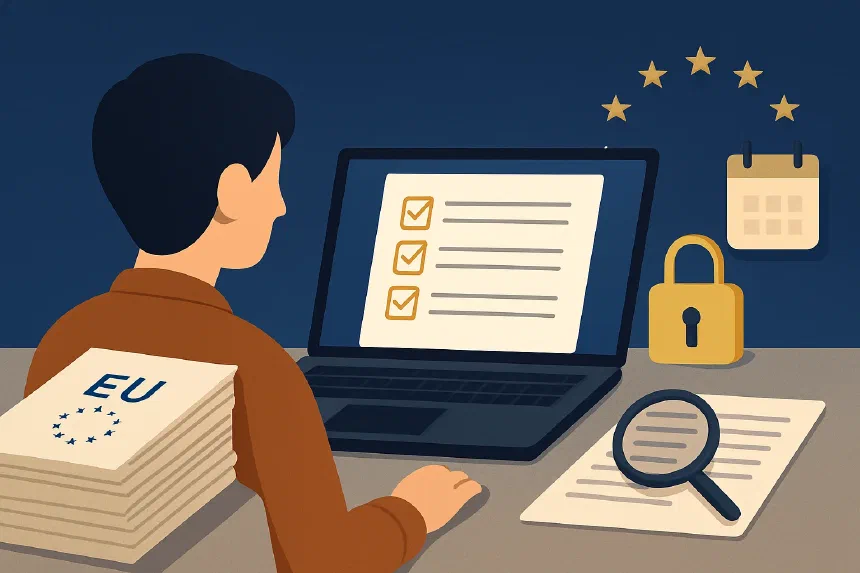
Legal status as of: 2026-05-20.
If you run a sole proprietorship (jednoosobowa działalność gospodarcza, JDG in Polish) or a small business and you think EU economic sanctions are a corporate problem — this article is for you. EU regulations in force in Poland contain no turnover threshold, no employee headcount limit, and no restriction based on legal form.1 Small businesses, freelancers, and the self-employed are subject to exactly the same rules as large enterprises. The only difference lies in the scale of risk and the scope of action proportionate to it — not in any exemption from the obligation.
TL;DR — the key points in 60 seconds
- EU regulations (including Nos 269/2014 and 833/2014) are directly applicable in Poland and cover every entity — regardless of size, turnover, or legal form.123
- As a sole trader or micro-business owner you bear personal liability for sanctions violations — exactly as a corporate director does.
- Sanctions matter if, among other things, you sell abroad, buy from suppliers in the East, provide digital services to EU customers, or work as a subcontractor for a larger company.
- You can meet the obligation with minimal effort: a procedure, free verification tools, and a hits register. No specialist software is needed to get started.
- The administrative fine in Poland for a sanctions breach can reach PLN 20,000,000 — imposed by the Head of the National Revenue Administration (Szef Krajowej Administracji Skarbowej, KAS).4
- Proportionality is the rule: the lower the risk in your business, the simpler the procedures that suffice. But having no procedures at all is a mistake.
I run a small business — do EU sanctions apply to me?
Yes, they do. And directly — not via a Polish statute, but directly by force of EU regulations.
A regulation is a specific type of EU legal act: it enters into force in all Member States simultaneously, without needing to be transposed into national law.3 Council Regulation (EU) No 269/2014 of 17 March 20141 and Council Regulation (EU) No 833/2014 of 31 July 20142 — both concerning Russia’s actions towards Ukraine and forming the basis of the most significant sanctions regime currently in force in Poland — apply to every business and every person operating within the EU. Neither regulation contains any article exempting a sole proprietorship, a two-person partnership, or a company with five employees.
The widespread belief that “I’m too small for this to apply to me” is understandable — banks do have large compliance departments, and it is banks that are most associated with sanctions screening. But banks are subject to additional, separate regulations (including the AML Act of 1 March 20185). You are subject to EU regulations — and that alone is sufficient for the obligation to arise.
For more detail on exactly who is subject to the sanction screening obligation, read the article Does my company have to carry out sanction screening?
Why there is no exemption for small businesses and sole traders
The logic of EU sanctions is straightforward: the system must be watertight. If large companies were required to verify counterparties but small ones were not, a sanctioned entity could simply conduct business through a network of small subcontractors. The regulations close that loophole.
EU regulations are directly applicable and binding in their entirety.3 This means Poland did not need to enact a separate provision “for sole traders” in order for the obligation to arise — the regulation entering into force was sufficient. The Act of 13 April 2022 on special solutions to counter support for aggression against Ukraine and to protect national security (Journal of Laws 2022, item 835)6 clarifies enforcement arrangements and penalties under Polish law, but does not restrict the personal scope of the obligation itself.
Also significant is the so-called ownership rule (ownership/control rule): sanctions cover not only individuals and entities listed explicitly, but also entities in which a listed person holds at least 50% of the ownership rights or exercises control over them.7 This means that even if your counterparty does not appear on the list by name, it may be covered indirectly — we explain this in detail in the article on the 50% ownership rule in sanctions. Small businesses that do not verify ownership structures expose themselves to a violation — unknowingly.
Real-life situations in which a sole trader encounters sanctions
Sanctions stop being an abstraction when you look at concrete scenarios. Here are situations in which a sole proprietorship or micro-business has genuine contact with a sanctions regime.
Cross-border trade — exports and imports. Do you sell products abroad or buy goods from suppliers in countries subject to restrictions? Regulation 833/20142 contains a list of goods and services whose export to Russia is prohibited — this applies to businesses of any size. If your supplier or customer turned out to be a sanctioned entity, the transaction would be unlawful regardless of whether you were aware of this.
Digital services and marketplace sales. If you provide digital services, sell via platforms (Amazon, Allegro, your own shop) and accept payments from around the world — your customer could be a person on a sanctions list. E-commerce businesses and digital freelancers are in exactly the same position as traditional companies.
Customers from east of the border. Russian or Belarusian nationals may legally reside and operate a business in Poland. Not all of them are subject to sanctions — but some are. Before entering into a contract with such a person, you should check them against the EU consolidated sanctions list8 and the Polish list maintained by the Ministry of the Interior and Administration (MSWiA).9
Subcontracting for larger companies. A growing number of large enterprises and institutions require their subcontractors to confirm that they operate sanctions procedures. If you are a subcontractor — the absence of your own procedure may result in losing a contract, even before any breach of the regulations occurs.
Property rental. If you rent premises to a company or private individual in which a sanctioned entity holds at least 50% of the ownership rights7 — you are indirectly violating sanctions. Estate agents and owners of commercial premises fall into this risk category. For more on the specifics of this sector, see the page Sanction screening for the property sector.
How a small business can meet the obligation with minimal effort
Good news: as a sole trader or micro-business you do not immediately need specialist software or your own compliance department. You can start with four concrete steps.
Step 1: Identify high-risk transactions. Review your current and prospective counterparties. Which business relationships involve foreign entities, particularly from the East? Which sectors or goods may be subject to restrictions? This risk analysis takes a few hours but allows you to focus attention where the risk is real.
Step 2: Gather the counterparty’s identifying data. For verification you need: the full company name or the individual’s full name, the tax identification number (NIP) or its foreign equivalent, and the country of registration. The more data you have, the lower the risk of a false positive.
Step 3: Check the counterparty against sanctions lists. Free public tools are available:
- The EU consolidated list maintained by DG FISMA (Directorate-General for Financial Stability, Financial Services and Capital Markets Union)8 — available free of charge online.
- The Polish sanctions list maintained by MSWiA9 — available on gov.pl.
- The EU Sanctions Map10 — an interactive map of EU sanctions, useful for analysing regimes.
Step 4: Document the verification. Record the date of the check, the tool used, and the result. If the counterparty is clear — a service note or a spreadsheet entry is sufficient. If a hit appears — do not proceed with the transaction, consult a lawyer, and report to the relevant authority. The detailed verification process is described in the article Verifying a counterparty against sanctions — step by step.
Step 5: Create a simple internal procedure. Even a one-page document describing when and how you verify counterparties protects you in the event of an inspection. It demonstrates that you take the obligation seriously — and that matters when assessing whether a violation was deliberate. We discuss ready-to-use templates for such a document in the article Sanctions policy — template and documents.
Proportionality — the scope of action tailored to your risk
EU sanctions legislation does not require every company to implement an enterprise-class system. The obligation exists — but the scope of the actions needed to satisfy it should be proportionate to the risk profile of your business.
What does this mean in practice? If you run a hairdressing salon and your customers are exclusively private individuals from Poland, the risk of contact with a sanctioned entity is virtually nil. Awareness of the obligation and a minimal procedure are enough. If, on the other hand, you import technical components from third countries, sell software to customers worldwide, or work with companies whose owners may have links to the East — the risk is higher and calls for a more systematic approach.
The proportionality principle is not an excuse to do nothing. It is a guide to doing as much as is necessary — and being able to justify it. If a supervisory authority asks how you verify counterparties, “we are a small business” is not a sufficient answer. “We assessed the risk and adopted a simplified procedure which we document” — that is an argument.
When it is worth thinking about automation
Manual verification in a spreadsheet works — but only up to a point. If the volume of transactions grows, you start handling more foreign counterparties, or your client or investor requires formal confirmation of compliance — manual processes become a risk in themselves: errors are easy to make, and an audit trail is hard to produce.
Automation makes sense when:
- you verify more than a handful of new counterparties each month,
- you operate in a higher-risk sector (e.g. travel, intermediation, import/export) — see the article Sanction screening for the travel sector,
- your business partner or bank requires evidence that you operate sanctions procedures,
- you want a verification result in seconds, not hours.
Sanqto offers sanction screening software installed within your own infrastructure (on-premise) — counterparty data never leaves your network. The system checks a counterparty simultaneously against multiple sanctions lists and returns a result in one of three states: MATCH, POSSIBLE, or CLEAR. It helps reduce the risk of oversight and automates documentation — without the need to build your own compliance department from scratch.
FAQ — the most common questions from sole traders and micro-businesses about EU sanctions
Can I actually be fined as a sole trader for breaching sanctions?
Yes. The administrative fine imposed by the Head of the National Revenue Administration (KAS) can reach PLN 20,000,0004 — and it applies to any entity regardless of legal form. As a sole trader you are personally liable with your own assets. The Act of 13 April 20226 provides for no threshold or exemption for small business owners. For more on penalties, see the article What penalties apply for breaching EU sanctions?
I only have Polish customers. Do sanctions apply to me?
To a limited extent — but you cannot be certain without verification. First, your supplier or subcontractor may be an entity indirectly covered by sanctions (via the 50% ownership rule7). Second, even a “Polish” company may be owned by a person on the sanctions list. The risk is low, but not zero.
How often must I verify counterparties?
Sanctions lists are updated regularly — new entities are added with each new package of sanctions. This means a one-off check at contract signing may not be sufficient for a long-term relationship. It is worth setting a schedule for re-verification — at least once a quarter, or whenever there is a significant change on the counterparty’s side.
Must I verify natural persons as well as companies?
Both. Sanctions lists include both legal persons (companies and institutions) and natural persons.8 If you enter into an agreement with a private individual — for example as a freelancer providing services — you should check their details against the list.
What should I do if the verification returns a possible hit (false positive)?
Do not discontinue the relationship hastily — a false positive is a situation in which your counterparty’s name resembles that of a listed person, but is not the same person. Compare detailed data: date of birth, nationality, identification number. Document the analysis. If doubts remain — consult a lawyer. Never proceed with a transaction where a hit remains unresolved.
Does a sanctions procedure need to be approved by any authority?
No — there is no obligation to register a procedure or obtain regulatory approval. An internal document describing how and when you verify counterparties is your evidence that you take the obligation seriously. It also provides protection in the event of an inspection or proceedings.
What to do — a step-by-step checklist for sole traders and micro-businesses
- Assess the risk — does your business involve foreign counterparties, goods on restricted lists, or higher-risk sectors?
- Identify counterparties for verification — start with active contracts involving foreign entities or those with an unclear ownership structure.
- Gather identifying data — full name, country, tax identification number or equivalent.
- Check against the lists — the EU consolidated list8, the Polish MSWiA list9, and optionally the EU Sanctions Map10.
- Document the result — date, tool used, outcome, signature of the person who carried out the check.
- Write a brief procedure — who verifies, when and how, and what to do if there is a hit.
- Set a reminder for re-verification — e.g. quarterly or upon contract renewal.
- Monitor legislative changes — new EU sanctions packages are announced by DG FISMA8; Directive (EU) 2024/1226 of 24 April 202411 tightens the criminalisation of violations.
Legal basis
- Council Regulation (EU) No 269/2014 of 17 March 2014 concerning restrictive measures in respect of actions undermining or threatening the territorial integrity, sovereignty and independence of Ukraine — CELEX 32014R0269
- Council Regulation (EU) No 833/2014 of 31 July 2014 concerning restrictive measures in view of Russia’s actions destabilising the situation in Ukraine — CELEX 32014R0833
- Council Regulation (EU) No 765/2006 of 18 May 2006 concerning restrictive measures in view of the situation in Belarus — CELEX 32006R0765
- Act of 13 April 2022 on special solutions to counter support for aggression against Ukraine and to protect national security (Journal of Laws 2022, item 835) — ISAP
- Directive of the European Parliament and of the Council (EU) 2024/1226 of 24 April 2024 on the definition of criminal offences and penalties for the violation of Union restrictive measures — CELEX 32024L1226
- Act of 1 March 2018 on counteracting money laundering and financing of terrorism (Journal of Laws 2018, item 723) — ISAP
- EU consolidated sanctions list — DG FISMA, European Commission — finance.ec.europa.eu
- Polish sanctions list — MSWiA — gov.pl/web/mswia
- EU Sanctions Map — sanctionsmap.eu
Footnotes
Information, not legal advice. This article is for informational and educational purposes only. It does not constitute legal advice. Legal status as of: 20 May 2026. The specific obligations applicable to your business depend on its activity profile and require individual assessment — if in doubt, consult a lawyer or compliance adviser.
Council Regulation (EU) No 269/2014 of 17 March 2014 concerning restrictive measures in respect of actions undermining or threatening the territorial integrity, sovereignty and independence of Ukraine, EUR-Lex CELEX:32014R0269 ↩︎ ↩︎ ↩︎
Council Regulation (EU) No 833/2014 of 31 July 2014 concerning restrictive measures in view of Russia’s actions destabilising the situation in Ukraine, EUR-Lex CELEX:32014R0833; see also: DG FISMA, Sanctions adopted following Russia’s military aggression against Ukraine ↩︎ ↩︎ ↩︎
EUR-Lex, “Regulation — EU legal act”: “A regulation is binding in its entirety and directly applicable in all Member States.” eur-lex.europa.eu ↩︎ ↩︎ ↩︎
Act of 13 April 2022 on special solutions to counter support for aggression against Ukraine (Journal of Laws 2022, item 835), Art. 6(2): “The financial penalty referred to in paragraph 1 is imposed by decision of the Head of the National Revenue Administration (Szef Krajowej Administracji Skarbowej) and amounts to up to PLN 20,000,000.” ISAP ↩︎ ↩︎
Act of 1 March 2018 on counteracting money laundering and financing of terrorism (Journal of Laws 2018, item 723), ISAP ↩︎
Act of 13 April 2022 on special solutions to counter support for aggression against Ukraine and to protect national security (Journal of Laws 2022, item 835), ISAP; Sejm API ELI ↩︎ ↩︎
DG FISMA, FAQ on the ownership/control rule: “An entity is considered as ‘owned’ by a sanctioned person if the latter owns more than 50% of its proprietary rights.” finance.ec.europa.eu ↩︎ ↩︎ ↩︎
DG FISMA (Directorate-General for Financial Stability, Financial Services and Capital Markets Union), European Commission — EU consolidated sanctions list and sanctions hub: finance.ec.europa.eu/eu-and-world/sanctions-restrictive-measures_en ↩︎ ↩︎ ↩︎ ↩︎ ↩︎
Polish list of persons and entities subject to sanctions — Ministry of the Interior and Administration (MSWiA): gov.pl/web/mswia/lista-osob-i-podmiotow-objetych-sankcjami ↩︎ ↩︎ ↩︎
EU Sanctions Map — interactive tool for browsing EU sanctions packages and their targets: sanctionsmap.eu ↩︎ ↩︎
Directive of the European Parliament and of the Council (EU) 2024/1226 of 24 April 2024 on the definition of criminal offences and penalties for the violation of Union restrictive measures; transposition deadline: 20 May 2025. EUR-Lex CELEX:32024L1226 ↩︎