Targeted vs sectoral sanctions — what's the difference and why your business must monitor both
EU sanctions split into targeted (asset freezes on specific entities) and sectoral (sector-wide embargoes). Learn how they differ and how to verify compliance with each.
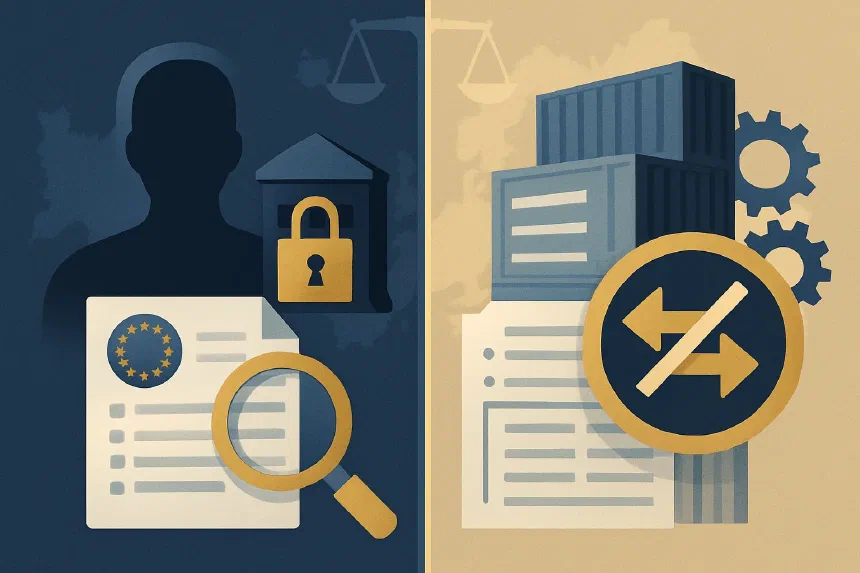
The EU’s sanctions regime against Russia operates through two fundamentally different legal mechanisms — and most businesses either confuse them or focus on only one. Targeted sanctions hit specific individuals and companies on a list. Sectoral sanctions block entire industries, categories of goods, and types of services — regardless of who you are trading with. Your business must monitor both simultaneously, because EU law makes no exceptions for SMEs or for sectors outside finance.
Legal status as of: 2026-05-20.
TL;DR — the key points in 60 seconds
- EU restrictive measures divide into targeted and sectoral — two separate legal regimes with separate legal acts and separate compliance obligations.
- Targeted sanctions (legal basis: Council Regulation (EU) No 269/20141) freeze the assets of specific individuals and entities on the list — obligation: screen every counterparty against the list before each transaction.
- Sectoral sanctions (legal basis: Council Regulation (EU) No 833/20142) impose sector-wide embargoes: bans on exporting/importing specified goods, prohibitions on providing certain services, financial restrictions — obligation: verify whether your product, service, or transaction is subject to a prohibition.
- Breaching either regime carries an administrative penalty of up to PLN 20 million3 and — following transposition of Directive (EU) 2024/12264 — criminal liability of at least 5 years’ imprisonment.5
- EU regulations apply directly — no national implementing act is required, and there is no minimum threshold for businesses.6
- The EU has so far adopted 20 packages of sanctions against Russia, the latest on 23 April 20267 — each successive package extends both categories.
Two types of EU sanctions — targeted and sectoral
When you say “sanctions against Russia”, EU law means two distinct things, and each works differently. This is not merely a matter of terminology — it is a fundamental distinction that determines what your business needs to look for and where.
The first type is targeted sanctions, also called individual or listed-person sanctions. They are directed at specific natural persons, companies, organisations, vessels, and aircraft. Their primary legal effect is an asset freeze and a prohibition on conducting any transactions with them. If your counterparty — or its owner — appears on the list, any payment, delivery, or contract with them is unlawful.
The second type is sectoral sanctions, also called sector embargoes. Rather than naming specific individuals, they prohibit entire categories of activity: the export and import of specified goods, the provision of certain services, the granting of financing in defined areas, and access to EU ports and airports for Russian carriers. Sectoral sanctions apply regardless of the identity of your counterparty — even if you are dealing with an entity that does not appear on any sanctions list, trading in a prohibited good or service means you are breaking the law.
Both regimes apply to your business simultaneously, by virtue of directly applicable EU law.6
Targeted sanctions — asset freezes on specific entities
What targeted sanctions involve
The legal basis for targeted sanctions against Russia is Council Regulation (EU) No 269/2014 of 17 March 2014.1 Article 2(1)–(2) of that Regulation states plainly: all funds and economic resources owned or controlled by persons listed in Annex I shall be frozen, and it shall be prohibited to make any funds or resources available to them — directly or indirectly.
The practical significance is straightforward: if a company or individual in your business circle appears on the list, your bank may block a payment transfer, and you may face liability for the breach — even if you were unaware of the listing.
Who is on the list — the 50 % ownership rule
The EU sanctions list covers natural persons, legal entities, organisations, vessels, and aircraft. After the 18th package of sanctions, adopted in July 2025, the number of individual listings exceeded 2,5008 — and the 19th and 20th packages extended that list further.
The ownership rule is critical: an entity is treated as subject to sanctions if a listed person holds more than 50 % of its shares.9 This means you must verify not only the name of your counterparty but also its ownership structure. A subsidiary controlled by a sanctioned oligarch is treated in exactly the same way as the oligarch himself.
Poland’s national sanctions list is maintained by the Minister of Internal Affairs and Administration (MSWiA — Minister Spraw Wewnętrznych i Administracji) — pursuant to Article 2(1) and Article 3(1) of the Act of 13 April 2022 on special solutions to counter support for aggression against Ukraine and to protect national security (Journal of Laws 2022, item 835).10 The MSWiA list is separate from the EU list and covers entities designated by Polish authorities.11
How to verify against targeted sanctions
Verifying against targeted sanctions means checking a specific person or company against at least three lists: the EU Consolidated List12, the Polish MSWiA list11, and — if your business has any connection to the US market — the SDN list maintained by OFAC (Office of Foreign Assets Control).13 For more on what sanctions lists are and how to check them, see our article What is a sanctions list and why does it affect your business?
Verification results should be documented. The Act of 1 March 2018 on countering money laundering and terrorist financing specifies a 5-year retention period for documentation held by obliged entities within the meaning of that Act14 — as a practical minimum, document every check with the date, result (CLEAR / MATCH / POSSIBLE), data source, and the person responsible. In the event of an inspection by the Head of KAS (the National Revenue Administration — Krajowa Administracja Skarbowa), this is your only evidence of good-faith action.
Sectoral sanctions — prohibitions across entire economic sectors
What sectoral sanctions involve
The legal basis for sectoral sanctions against Russia is Council Regulation (EU) No 833/2014 of 31 July 20142 — and it is this regulation, not Regulation 269/2014, that governs goods embargoes, services bans, and financial restrictions. Article 2(1) of Regulation 833/2014 prohibits the sale, supply, transfer or export — directly or indirectly — of dual-use goods and technology to any person, entity, or body in Russia, or for use in Russia, where those items may be used for military purposes.2
Sectoral sanctions do not operate like a list of names. At their core is a list of goods (CN codes), services, and financial transactions that cannot be carried out with or in favour of Russia, regardless of who is on the other side of the contract.
Which sectors and goods are covered
Regulation 833/2014, as extended by successive sanctions packages, covers several key areas:
Goods and technology — prohibition on the export of dual-use goods and technology to military end-users or for potential military application.2 The CN codes subject to the ban are set out in Annex II and subsequent annexes to Regulation 833/201415 — the full list is available in the consolidated text in EUR-Lex and in the TARIC database.16 Luxury goods above the value threshold defined in the regulation’s annexes are also subject to an export ban.
Services — Article 5n of Regulation 833/201417 prohibits the provision of a range of professional services to the Russian government and to entities established in Russia, including management consulting, public relations, IT services, accounting services, and (with certain exceptions for access to justice) legal advisory services. A full FAQ on the scope of Article 5n is available on the DG FISMA website.17
Transport — prohibition on entry into the EU for Russian road operators and their trailers, and for vessels sailing under a Russian flag or manipulating navigation systems while carrying Russian oil.18
No re-export clause — from the 11th package of sanctions (23 June 2023) onwards, Article 12g of Regulation 833/20141920 requires EU exporters to include in their contracts a clause prohibiting the resale of specified goods to Russia via third countries. This applies to dual-use goods and other items listed in the regulation’s annexes. If you export to countries identified as higher-risk for sanctions circumvention, this obligation directly concerns you.
If your business trades in goods or provides services covered by any of these prohibitions, you are breaching sectoral sanctions — even if your counterparty does not appear on any targeted list. For detail on the goods embargo and verification tools, see our article Russia embargo — a practical guide for exporting and importing businesses.
Comparison table — targeted vs sectoral sanctions
| Feature | Targeted sanctions | Sectoral sanctions |
|---|---|---|
| Legal basis | Reg. (EU) No 269/20141 | Reg. (EU) No 833/20142 |
| What they do | Freeze assets of specific entities; prohibit transactions with listed persons | Prohibit entire sectors: goods embargoes, services bans, financial restrictions |
| Criterion | Identity of counterparty (name / company name / ownership structure) | Type of good, service, or financial transaction |
| How to verify | Screen counterparty against sanctions lists (EU, MSWiA, OFAC) | Check CN code of goods in TARIC, classify service against Article 5n |
| Does it apply to counterparties not on a list? | No — prohibition applies only to listed entities or entities they control | Yes — prohibition applies to the good/service regardless of counterparty identity |
| Number of entries (EU) | Over 2,500 after the 18th package8 | Hundreds of CN codes and service categories |
| Enforcing authority in Poland | Head of KAS (administrative penalties), public prosecutor (criminal liability)21 | Head of KAS / Tax Administration Chamber — customs control21 |
| Maximum administrative penalty | Up to PLN 20 million3 | Up to PLN 20 million3 |
How a business verifies compliance with each type of sanction
Verifying targeted sanctions — counterparty screening
Verifying against targeted sanctions means checking the identifying details of the counterparty (full name or company name, country of registration, identification number) against sanctions lists before entering into a contract and before executing each significant transaction. The minimum set of lists a Polish business should check is the EU Consolidated List (DG FISMA12) and the Polish MSWiA list.11 If you have relationships with US-connected entities or conduct transactions in US dollars, you should also check the OFAC SDN list.13
An important trap: entering the company name alone is not enough. You must also analyse the ownership structure of your counterparty — the 50 % rule means that a subsidiary of a sanctioned entity is subject to the same prohibitions, even if its own name does not appear on any list.9
Every check is worth recording — the date of verification, the result (CLEAR / MATCH / POSSIBLE), the data source, and the person responsible. In the event of an inspection by the Head of KAS, this record is your only evidence of acting in good faith.
Verifying sectoral sanctions — classifying the good or service
Verifying sectoral sanctions is not about the identity of the counterparty, but about what you are selling, buying, or providing as a service. The process works as follows:
- Establish the CN code of the good or the category of the service.
- Check the CN code in the TARIC database16 — TARIC displays the applicable trade measures, including sanctions embargoes, directly alongside the goods code.
- For services: check whether the service falls within the scope of Article 5n of Regulation 833/201417 or other services prohibitions (IT, consulting, PR, accounting).
- If you export to third countries: check the no re-export clause obligation under Article 12g1920 and include it in your contract.
- Document the outcome of the classification.
For information on how to carry out a full sanction screening process from the ground up, see our article Does my business need to conduct sanction screening?
Why your business must monitor both simultaneously
The most common mistake businesses make is assuming: “I check my counterparty against the list — that’s enough.” This is a dangerous oversimplification. Both regimes are independent of each other, and each can be breached without breaching the other.
Imagine you buy metal from a counterparty who does not appear on any targeted sanctions list — all screenings return CLEAR. But if the metal is a good covered by Annex II to Regulation 833/2014 and it is being exported to Russia or to a transit country, you are breaching sectoral sanctions. The reverse situation is equally possible: a product entirely outside the scope of sectoral sanctions, but purchased from a company controlled by a listed person. Obligation breached.
Directive (EU) 2024/1226 of the European Parliament and of the Council of 24 April 20244 raised the stakes — its Article 5(3)(b) requires Member States to provide for a custodial sentence of at least 5 years’ maximum where the offence concerns funds or economic resources worth at least EUR 100,000.5 The transposition deadline for Member States was 20 May 2025.22 Poland is currently in the legislative process of transposing this Directive — the implementing bill is progressing at national level.22
EU regulations require no minimum threshold — they apply to every business, regardless of size or turnover.1 A breach carries an administrative penalty of up to PLN 20,000,000 imposed by the Head of the National Revenue Administration (KAS).321
FAQ
Do targeted sanctions apply only to banks?
No. Regulation (EU) No 269/20141 and the Act of 13 April 202223 apply to every person and entity in the EU, with no sectoral exceptions. Banks do have sophisticated verification systems, but estate agents, travel agencies, leasing companies, and property developers are subject to the same rules. The difference is only that banks have dedicated procedures — and you need to build yours, independently or with the help of an external tool.
Do sectoral sanctions apply only to exporters?
No — they also apply to imports, the provision of services, and financing. If you import from Russia goods subject to a ban, provide advisory services to a Russian company, or extend a loan to an entity established in Russia in a prohibited sector, you are breaching sectoral sanctions — regardless of the direction of the flow of goods or funds.
What is the 50 % rule and why does it matter?
The 50 % rule means that an entity is treated as subject to targeted sanctions if a listed person holds — directly or indirectly — more than 50 % of its shares or voting rights.9 In practice, you must check not only the name of the counterparty’s company, but also its ownership structure. This is particularly important for counterparties from Eastern European jurisdictions, where the true beneficial owners are often concealed behind multi-layered holding structures.
How often should I screen counterparties for targeted sanctions?
Sanctions lists change with each successive EU package — since 2022 there have already been 20 packages,7 the latest in April 2026. A single one-off check before signing a contract is not sufficient. A counterparty may be listed after the contract is concluded — at that point you must suspend performance and notify the competent authorities without delay. Industry best practice points to the need for periodic re-screening of existing counterparties, particularly under long-term contracts.
Must I check both the EU list and the Polish MSWiA list?
Yes. These are two separate lists with separate legal bases. The EU Consolidated List derives from EU regulations1 and is directly binding on all entities in the EU. The Polish MSWiA list derives from the Act of 13 April 202223 and is maintained by the Minister of Internal Affairs and Administration (MSWiA).10 An entity may appear on one list but not the other. For more on individual sanctions lists, see our article What is a sanctions list and why does it affect your business?
What is the difference between EU sanctions and OFAC sanctions?
EU sanctions — both targeted (Reg. 269/20141) and sectoral (Reg. 833/20142) — apply directly to every company registered or operating in the EU.6 OFAC sanctions (Office of Foreign Assets Control, U.S. Department of the Treasury24) are based on US law and apply in principle to US entities and to transactions with a US nexus — in particular transactions conducted in US dollars, involving US entities, or concerning goods of US origin. If your business has no connection whatsoever to the United States, OFAC sanctions may affect you indirectly (for example through a correspondent bank). Checking the OFAC SDN list13 is good practice even where the strict legal obligation to do so depends on the specifics of your business.
Legal basis
- Council Regulation (EU) No 269/2014 of 17 March 2014 concerning restrictive measures in respect of actions undermining or threatening the territorial integrity, sovereignty and independence of Ukraine — CELEX 32014R0269
- Council Regulation (EU) No 833/2014 of 31 July 2014 concerning restrictive measures in view of Russia’s actions destabilising the situation in Ukraine — CELEX 32014R0833
- Act of 13 April 2022 on special solutions to counter support for aggression against Ukraine and to protect national security (Journal of Laws 2022, item 835) — eli.gov.pl
- Directive of the European Parliament and of the Council (EU) 2024/1226 of 24 April 2024 on the definition of criminal offences and penalties for the violation of Union restrictive measures — CELEX 32024L1226
- Act of 1 March 2018 on countering money laundering and terrorist financing (Journal of Laws 2023, item 1124) — eli.gov.pl
- DG FISMA FAQ — EU sanctions against Russia and Belarus (Article 5n — services): finance.ec.europa.eu/publications/provision-services_en
- DG FISMA FAQ — no re-export clause (Article 12g): finance.ec.europa.eu/publications/no-re-export-russia-clause_en
- EU Sanctions Map — interactive map of sanctions regimes: sanctionsmap.eu
- TARIC — customs code database with sanctions measures: ec.europa.eu/taxation_customs/dds2/taric
- MSWiA list (Polish national sanctions list): gov.pl/web/mswia/lista-osob-i-podmiotow-objetych-sankcjami
How Sanqto can help
Sanqto is sanctions screening software installed directly within your company’s own infrastructure (on-premise model) — counterparty data never leaves your servers. The system checks counterparties against up-to-date sanctions lists and returns a result in one of three states: MATCH, POSSIBLE, or CLEAR, enabling you to standardise decisions and document every check. If you run an estate agency, a travel company, or a business in any other sector subject to a verification obligation, Sanqto helps you automate that process without the need to build an in-house compliance team. For more on how screening works in practice for real estate businesses, see our industry page for estate agents or for travel agencies.
Information, not legal advice. This article is for informational and educational purposes only. It does not constitute legal advice. Legal status as of: 20 May 2026. Your company’s specific obligations depend on its business profile and require individual assessment — if in doubt, consult a lawyer or compliance adviser.
Council Regulation (EU) No 269/2014 of 17 March 2014, Article 2(1)–(2) — CELEX 32014R0269 — quote: “All funds and economic resources belonging to, owned, held or controlled by natural or legal persons, entities or bodies listed in Annex I shall be frozen.” ↩︎ ↩︎ ↩︎ ↩︎ ↩︎ ↩︎ ↩︎
Council Regulation (EU) No 833/2014 of 31 July 2014, Article 2(1) — CELEX 32014R0833 — quote: “It shall be prohibited to sell, supply, transfer or export, directly or indirectly, dual use goods and technology, whether or not originating in the Union, to any natural or legal person, entity or body in Russia or for use in Russia.” ↩︎ ↩︎ ↩︎ ↩︎ ↩︎ ↩︎
Act of 13 April 2022, Article 6(2) — eli.gov.pl — quote: “The financial penalty shall be imposed by the Head of the National Revenue Administration, by decision, in an amount of up to PLN 20,000,000.” ↩︎ ↩︎ ↩︎ ↩︎
Directive of the European Parliament and of the Council (EU) 2024/1226 of 24 April 2024 on the definition of criminal offences and penalties for the violation of Union restrictive measures — CELEX 32024L1226 ↩︎ ↩︎
Directive (EU) 2024/1226, Article 5(3)(b) — CELEX 32024L1226 — quote: “offences referred to in Article 3(1)(a), (b) and (h)(i) and (ii) are punishable by a maximum term of imprisonment of at least five years” — applies to breaches involving funds or economic resources worth at least EUR 100,000. ↩︎ ↩︎
Regulation — EU legal act — EUR-Lex — eur-lex.europa.eu — quote: “A regulation is binding in its entirety and directly applicable in all Member States.” ↩︎ ↩︎ ↩︎
Sanctions adopted following Russia’s military aggression against Ukraine — DG FISMA (last updated 23 April 2026), finance.ec.europa.eu — quote: “Latest update: 23 April 2026 - 20th package of sanctions against Russia.” ↩︎ ↩︎
EU adopts 18th package of sanctions against Russia — DG FISMA — finance.ec.europa.eu — quote: “the number of individual listings exceeds 2500.” The number following the 19th and 20th packages is higher. ↩︎ ↩︎
EU FAQ — 50 % ownership rule — DG FISMA — finance.ec.europa.eu — quote: “An entity is considered as ‘owned’ by a sanctioned person if the latter owns more than 50% of its proprietary rights.” ↩︎ ↩︎ ↩︎
Act of 13 April 2022, Article 2(1) and Article 3(1) — eli.gov.pl — quote: “The list of persons and entities to whom measures are applied […] shall be maintained by the minister responsible for internal affairs.” ↩︎ ↩︎
List of persons and entities subject to sanctions — MSWiA — gov.pl ↩︎ ↩︎ ↩︎
Consolidated List of financial sanctions — DG FISMA — finance.ec.europa.eu — database available at: webgate.ec.europa.eu/fsd/fsf ↩︎ ↩︎
Specially Designated Nationals And Blocked Persons List (SDN) — OFAC — ofac.treasury.gov ↩︎ ↩︎ ↩︎
Act of 1 March 2018 on countering money laundering and terrorist financing, Article 49 — eli.gov.pl — quote: “Obliged entities shall retain [records] for a period of five years, counting from the first day of the year following the year in which the business relationship ended.” Applies to obliged entities within the meaning of that Act. ↩︎
Council Regulation (EU) No 833/2014, Annex II — CELEX 32014R0833 — list of technologies with CN codes. Full list of CN codes in the consolidated text in EUR-Lex and in the TARIC database. ↩︎
TARIC Consultation — European Commission — ec.europa.eu/taxation_customs/dds2/taric — last TARIC update: 19-05-2026. ↩︎ ↩︎
Provision of services — FAQs on sanctions against Russia and Belarus, Article 5n of Reg. (EU) No 833/2014 — DG FISMA — finance.ec.europa.eu/publications/provision-services_en ↩︎ ↩︎ ↩︎
Sanctions adopted following Russia’s military aggression against Ukraine — Transport section — DG FISMA — finance.ec.europa.eu — quote: “Prohibition on Russian freight operators and on the use of Russian trailers and semi-trailers.” ↩︎
FAQs on “No re-export to Russia” clause — Article 12g of Reg. (EU) No 833/2014 — DG FISMA (18 December 2024) — finance.ec.europa.eu/publications/no-re-export-russia-clause_en — the 11th package of 23 June 2023 introduced Article 12g. ↩︎ ↩︎
Ibid — legal basis: Article 12g of Council Regulation (EU) No 833/2014. ↩︎ ↩︎
Act of 13 April 2022, Article 6(2) — api.sejm.gov.pl — quote: “The financial penalty shall be imposed by decision of the Head of the National Revenue Administration.” Enforcement of goods embargoes in the customs sphere falls to the Tax Administration Chamber (Izba Administracji Skarbowej). ↩︎ ↩︎ ↩︎
Directive (EU) 2024/1226, Article 20(1) — CELEX 32024L1226 — quote: “Member States shall adopt and publish, by 20 May 2025, the laws, regulations and administrative provisions necessary to comply with this Directive.” ↩︎ ↩︎
Act of 13 April 2022 on special solutions to counter support for aggression against Ukraine and to protect national security (Journal of Laws 2022, item 835) — eli.gov.pl ↩︎ ↩︎
Office of Foreign Assets Control — U.S. Department of the Treasury — ofac.treasury.gov ↩︎