Sanctions in Transport and Freight Forwarding — a Practical Guide for Companies
Transport and freight forwarding are high-risk for sanctions. Learn to screen clients, consignees, and subcontractors and avoid fines of up to PLN 20 million.
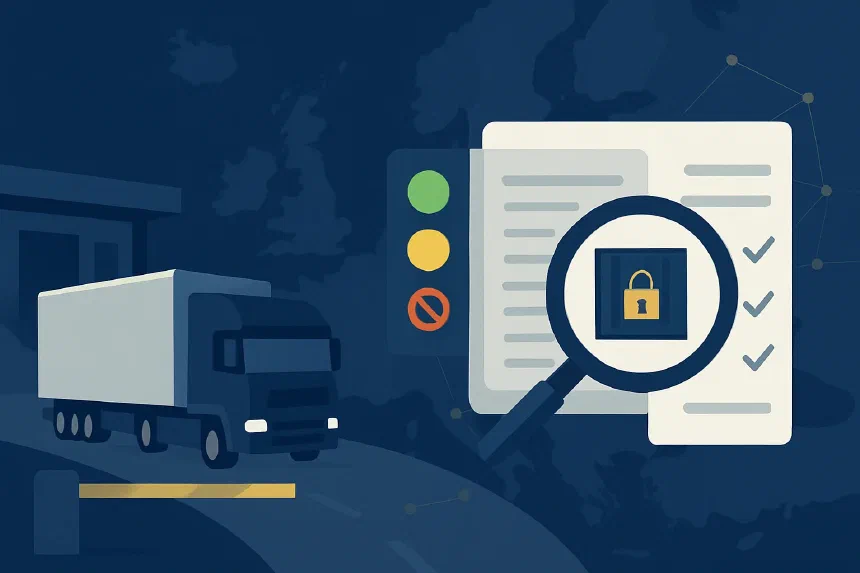
A transport or freight-forwarding company can breach EU sanctions without knowing it — and far more easily than companies in other sectors. All it takes is carrying embargoed goods, accepting an order from a sanctioned entity, or arranging a transit route through a high-risk country without proper verification. The consequences include an administrative fine of up to PLN 20,000,000 imposed by the Head of the National Revenue Administration (Szef Krajowej Administracji Skarbowej, KAS)1 — and a growing risk of personal criminal liability.
This article explains exactly what a company operating in the TSL sector (transport, freight forwarding, logistics) must check before accepting an order, and how to do it in practice.
Legal status as of: 2026-05-20.
TL;DR — key points in 60 seconds
- EU Regulations No. 269/20142 and No. 833/20143 apply to every transport and freight-forwarding company operating in the EU — with no exemption for sector, size, or legal form.4
- The EU has adopted 20 packages of sanctions against Russia5; the prohibition on entry covers Russian road transport operators and Russian trailers on EU territory.6
- You must screen three parties to each order: the client (ordering party), the consignee, and — when transport is sub-contracted — the performing carrier itself.
- The “No re-export to Russia” obligation (Art. 12g of Regulation 833/2014)78 applies to exporters of dual-use goods; a freight forwarder arranging the shipment should obtain confirmation that the exporter has fulfilled this requirement.
- Ownership rule: an entity owned more than 50% by a person on the sanctions list is itself subject to sanctions — check the owners, not just the company name.9
- Administrative fine up to PLN 20,000,000 (imposed by the Head of KAS)1; for an intentional breach involving assets worth at least EUR 100,000 — a custodial sentence with a maximum of at least 5 years (Directive 2024/1226, Art. 5(3)(b))10.
Why transport and freight forwarding are high-risk sectors for sanctions
The TSL sector sits at the centre of the flow of goods between Russia, third countries, and the EU. A road haulier, sea freight forwarder, or logistics operator is not a neutral participant in the supply chain — it is an active party to a transaction and must comply with EU law regardless of what the exporter or importer does.
EU regulations have direct effect in all Member States — they require no national implementing legislation and apply from the date they enter into force.4 This means that a transport company registered in Poland is subject to Council Regulation (EU) No. 269/2014 of 17 March 2014 and Council Regulation (EU) No. 833/2014 of 31 July 2014 in exactly the same way as a bank or a trading company. The argument “we only carry goods, we don’t trade” provides no basis for exclusion from these rules — the sanction screening obligation applies to every party to a transaction, not only exporters.
By May 2026, the European Union had adopted 20 packages of sanctions against Russia5, each of which progressively extended trade prohibitions, expanded the lists of sanctioned entities, and refined the transport-sector bans. After the 18th package, the number of individual entries on the EU consolidated list (under Regulation 269/2014) exceeded 2,500 persons and entities.11 The figure is higher still after the 19th and 20th packages. Each of those entries is a potential counterparty — or owner of a counterparty — that you must verify.
In practice, sanctions risk in TSL arises at several stages simultaneously: when accepting an order, when selecting a subcontractor, when planning a route, and when handling customs documentation. None of these stages may be skipped.
Specific risks: embargoed goods, sanctioned counterparty, high-risk route
Embargoed goods
If you are carrying goods that are subject to an export or import prohibition under Regulation 833/2014, you are participating in an unlawful transaction — regardless of whether you know what is in the load. The embargo covers broad categories of goods, including dual-use goods and technologies, advanced military technologies, luxury goods above the value threshold set out in the annex to the regulation, energy raw materials (in the direction of imports from Russia), and steel and iron products.3
Prohibited goods are identified by Combined Nomenclature (CN) codes listed in the annexes to Regulation 833/2014.12 As a freight forwarder or carrier you should have access to transport documents and should verify the CN codes of cargoes before accepting an order — particularly for routes to Russia, Belarus, or through third countries via which goods might reach those destinations. You can check CN codes using the European Commission’s TARIC database.13
A counterparty appearing on the sanctions list
This risk is different in character from a trade embargo. Here the problem lies not in the type of cargo but in who is paying for the transport or who benefits from it. Regulation 269/2014 prohibits making funds and economic resources available — and a transport service is an economic resource — to the persons and entities listed in the annex to the regulation.2
The key rule: an entity owned more than 50% by a person on the sanctions list is itself subject to sanctions — even if its name does not appear on the list.9 This means that checking the company name alone is not sufficient. You must examine the ownership structure of the ordering party and the consignee — at least to the extent available in public registers.
A route through a high-risk country
Transit through countries that have documented historical commercial ties with Russia and high re-export activity is a separate category of risk. The European Commission has identified third countries that pose a particularly high risk of sanctions circumvention — these are countries bordering Russia or traditionally linked to it economically, through which a significant proportion of goods destined for Russia pass.14 A transport company organising a route to or through such a country must carry out enhanced verification of both the parties to the transaction and the nature of the cargo.
A detailed discussion of the mechanisms used to circumvent sanctions via transit countries can be found in the article How Russia Evades Sanctions Through Third Countries.
Who to screen — ordering party, consignee, performing carrier
Sanctions screening in transport and freight forwarding covers more parties than in a typical commercial transaction. You must check every party that may be a beneficiary of the service or a party to a financial transaction.
The ordering party is the entity that commissions you to carry or forward the goods. It is the contracting party and the payer — you are making economic resources (a service) available to it, so if it appears on the sanctions list the transaction is prohibited.2 Verification must be carried out before the contract is signed or the order accepted, not after.
The consignee is often a party that has no direct contractual relationship with you — but is the actual beneficiary of the transport. If your service enables delivery of goods to a sanctioned entity, you are also in breach of the prohibition under Regulation 269/2014. In practice, freight forwarders frequently do not know the end consignee because they know only the ordering party — and it is precisely this gap that is the typical scenario for an unintentional sanctions breach.
The performing carrier — in the freight-forwarding model, where you arrange transport and sub-contract it to a third party, that subcontractor must itself be screened. The use of a Russian road transport operator or Russian trailers is expressly prohibited.6 If the subcontractor appears on the sanctions list and you pay it for a service, you are in breach of the prohibition on making funds available.
A step-by-step guide to building a counterparty verification procedure from scratch is set out in the article counterparty verification for EU sanctions.
The shadow fleet and maritime transport
Maritime transport has its own, specific layer of sanctions risk. Since the introduction of the oil embargo, Russia has been actively using the so-called shadow fleet — vessels with opaque ownership structures, deregistered from Western registries and operating under the flags of countries not participating in sanctions. These ships frequently disable their AIS (Automatic Identification System) transmitters when calling at Russian ports, and change their names and flags to conceal their actual routes.
Regulation 833/2014, as applied through successive sanctions packages, introduces a prohibition on entry to EU ports for vessels flying the Russian flag and for vessels that disable or manipulate navigation systems when transporting Russian oil.6 This ban applies not only to shipowners but also to port operators, maritime agents, and entities servicing these vessels in EU ports.
If you operate in the areas of port handling, maritime agency, or sea logistics, you must screen the vessels you service — not just their direct owners. Identifying the ownership links between a vessel and Russian structures (often multi-layered, involving companies registered in offshore jurisdictions) is one of the most challenging compliance tasks in maritime transport.
Sanctions clauses in contracts of carriage and freight forwarding
A sanctions clause in a contract is a mechanism that allows you to withdraw from an order without financial consequences if it becomes apparent that performing it would breach EU sanctions. Without such a clause you may be exposed to a claim from your counterparty for non-performance — even when your reason for refusing is sanctions risk.
A well-drafted sanctions clause should provide for at least:
- the right to withdraw from the contract or suspend performance of the order if it is found that performance would breach EU, UN, or other applicable sanctions;
- an obligation on the ordering party to declare that persons and entities on the consignee’s side, to the best of its knowledge, do not appear on sanctions lists;
- exclusion of the carrier’s or freight forwarder’s liability for damages in the event of refusal to perform for sanctions-related reasons.
If you are arranging the export of dual-use goods or goods in categories subject to the obligation under Art. 12g of Regulation 833/2014 to third countries, you should also ensure that the exporter provides you with confirmation that it has obtained from the buyer the required declaration prohibiting re-export to Russia.78 The freight forwarder itself is not the exporter within the meaning of that provision, but by organising the transport it is participating in the execution of an export transaction.
A sanctions clause is standard in contracts of companies active in cross-border markets. Its absence from a contract is a signal that the company does not manage sanctions risk in a systematic way.
What to do when an order raises concerns — checklist
If an order raises sanctions concerns, do not accept it automatically and do not reject it without analysis. Carry out the following steps.
Screen the ordering party against the EU consolidated sanctions list (Consolidated List, DG FISMA)15 and the Polish MSWiA (Ministry of Interior and Administration) list.16 If the result is MATCH or POSSIBLE — take no steps towards performance until the matter has been clarified.
Screen the consignee — if known. If the freight forwarder has not received the consignee’s details, request them from the ordering party before confirming acceptance of the order.
Check the ownership structure of the ordering party and the consignee. Bear in mind the ownership rule: an entity owned more than 50% by a person on the sanctions list is itself subject to sanctions.9
Check the CN code of the cargo in the TARIC database13. If the goods are subject to an export or import embargo, performing the order on that route is prohibited — regardless of who the ordering party is.
Assess the route. If the destination country or a transit country is one with a high risk of sanctions circumvention14, carry out enhanced verification of both the parties to the transaction and the declared destination of the cargo.
Document the results of the verification. Record the date, the entity’s details, which list was checked, the outcome, and the decision taken. This is your evidence of due diligence in the event of an inspection by the Head of KAS or criminal proceedings.
In case of doubt — consult a compliance adviser or lawyer before accepting the order. A decision to refuse or to accept an order despite justified concerns should be made consciously and documented.
Penalties for sanctions breaches in transport
Breaching EU sanctions in the transport sector carries the same range of legal consequences as in any other sector — there is no sector-specific mitigation.
| Type of breach | Legal basis | Possible sanction |
|---|---|---|
| Performing transport for a sanctioned entity | Reg. 269/2014, Art. 22; Act of 13 April 2022, Art. 6(2)1 | Administrative fine up to PLN 20,000,000 — imposed by the Head of KAS17 |
| Carrying goods subject to an export embargo to Russia | Reg. 833/2014, Art. 23; Act of 13 April 2022 | Administrative financial penalty |
| Using a Russian road transport operator or Russian trailers | Reg. 833/20146 | Breach of the prohibition under Regulation 833/2014 |
| Intentional breach involving assets worth ≥ EUR 100,000 | Directive (EU) 2024/1226, Art. 5(3)(b)10 | Custodial sentence with a maximum of at least 5 years |
The authority responsible for imposing administrative penalties is the Head of the National Revenue Administration (KAS) (Art. 6(2) of the Act of 13 April 2022 on special measures to counter support for aggression against Ukraine and to protect national security, Journal of Laws 2022, item 835).117 This penalty does not require proof of intent — what is decisive is whether the company demonstrated due diligence and documented it.
Directive of the European Parliament and of the Council (EU) 2024/1226 of 24 April 2024 on the definition of criminal offences and penalties for the violation of Union restrictive measures required EU Member States to criminalise sanctions breaches — the implementation deadline was 20 May 2025.18 In Poland, legislative work on the national implementing act is ongoing.
A full discussion of penalties and their legal bases can be found in the article what penalties apply for sanctions breaches in Poland and the EU?.
FAQ — frequently asked questions
Does a transport company have to screen all clients, or only those from Russia?
The verification obligation applies to all ordering parties and consignees — regardless of their country of registration. The EU sanctions list covers entities from all over the world, not only those registered in Russia. An entity based in Germany that is owned more than 50% by a person on the sanctions list is itself subject to sanctions.9 Selective screening — “we only check those from Russia” — does not meet the due-diligence standard.
Am I allowed to carry cargo if I do not know what is inside?
Not knowing the contents of the cargo does not relieve a company of liability if it has taken no verification steps whatsoever. In practice, a freight forwarder should at minimum have transport documents containing a description of the goods and a CN code, and in case of doubt should have a contractual right to refuse carriage. The principle of due diligence requires proportionate verification effort — not absolute knowledge of every item in the load.
Does the ban on Russian lorries also apply to subcontractors?
Yes. If, as a freight forwarder, you commission transport to a subcontractor who uses Russian vehicles or trailers, or who is itself a Russian operator — you are in breach of the prohibitions under Regulation 833/2014.6 Screening subcontractors is just as important as screening ordering parties.
When does a sanctions clause in a contract become mandatory?
A sanctions clause is not explicitly required by Polish or EU law as a contractual term — but its absence exposes you to a claim from your counterparty if you refuse to perform an order for sanctions-related reasons. Without the clause, a refusal to perform may be treated as a contractual breach — even though your reason for refusing is compliance with the law. In practice, every contract of carriage or freight forwarding on routes with sanctions risk should contain such a clause.
What is the shadow fleet and how can you identify it?
The shadow fleet consists of vessels operating outside Western insurance and registration infrastructure, frequently changing their names and flags, with a history of AIS blackouts in the vicinity of Russian ports. Identification relies on analysis of a vessel’s history (previous flags, owners, ports of call), data from AIS monitoring systems, and information available in commercial maritime intelligence databases. Direct verification against sanctions lists (shipowner, operator, manager) is the minimum — thorough verification in maritime transport requires deeper due diligence.
How long should sanctions-screening documentation be retained?
The Act of 1 March 2018 on countering money laundering and the financing of terrorism (Journal of Laws 2023, item 1124) provides that obliged institutions (Dz.U. 2023 poz. 1124) must retain documentation for 5 years, calculated from the first day of the year following the year in which the business relationship ended.19 Companies outside the AML obliged-entity category should treat this period as a reasonable standard of prudence, bearing in mind that verification documentation fulfils its evidential role more effectively the more complete it is and the longer it is retained.
How Sanqto can help
Sanqto is sanctions-screening software installed within your company’s own infrastructure — data on ordering parties, consignees, and subcontractors never leaves your network. The system screens entities against the EU consolidated list, the Polish MSWiA list, and the OFAC list, returning a result in three states: MATCH, POSSIBLE, or CLEAR. Every screening is automatically documented, providing a ready audit trail to present in the event of an inspection by the Head of KAS. The implementation package includes template sanctions clauses for contracts of carriage and freight forwarding, a sanctions policy, and a position-level operating procedure. If you operate in sectors where sanctions screening involves specific challenges, see also our sector pages for travel agencies and OTAs and estate agents.
Legal basis
Legal status as of: 2026-05-20.
Council Regulation (EU) No. 269/2014 of 17 March 2014 concerning restrictive measures in respect of actions undermining or threatening the territorial integrity, sovereignty and independence of Ukraine — CELEX 32014R0269
Council Regulation (EU) No. 833/2014 of 31 July 2014 concerning restrictive measures in view of Russia’s actions destabilising the situation in Ukraine — CELEX 32014R0833
Act of 13 April 2022 on special measures to counter support for aggression against Ukraine and to protect national security (Journal of Laws 2022, item 835) — ELI
Directive (EU) 2024/1226 of the European Parliament and of the Council of 24 April 2024 on the definition of criminal offences and penalties for the violation of Union restrictive measures and on facilitating such violations, and amending Directive (EU) 2018/1673 — CELEX 32024L1226
Act of 1 March 2018 on countering money laundering and the financing of terrorism (Journal of Laws 2023, item 1124, consolidated text) — ELI
DG FISMA — Russia sanctions page (package timeline, FAQs, list files): finance.ec.europa.eu
DG FISMA — transport-sector prohibitions: “Transport” section on the DG FISMA page — finance.ec.europa.eu
DG FISMA — FAQ “No re-export to Russia” clause (Art. 12g of Reg. 833/2014): finance.ec.europa.eu/publications/no-re-export-russia-clause_en
TARIC Consultation (European Commission): ec.europa.eu/taxation_customs/dds2/taric/taric_consultation.jsp
Polish sanctions list — MSWiA (Ministry of Interior and Administration): gov.pl/web/mswia/lista-osob-i-podmiotow-objetych-sankcjami
Implementation of Directive 2024/1226 in Poland — implementing legislation in progress (status: May 2026); track progress at legislacja.rcl.gov.pl
Footnotes
Information, not legal advice. This article is for informational and educational purposes only. It does not constitute legal advice. Legal status as of: 2026-05-20. Your company’s specific obligations depend on its business profile and require individual assessment — if in doubt, consult a lawyer or compliance adviser.
Act of 13 April 2022 on special measures to counter support for aggression against Ukraine and to protect national security (Journal of Laws 2022, item 835), Art. 6(2): “The financial penalty shall be imposed by the Head of the National Revenue Administration [Szef Krajowej Administracji Skarbowej], by way of a decision, in an amount of up to PLN 20,000,000.” ELI: https://eli.gov.pl/eli/DU/2022/835/ogl/pol/html ↩︎ ↩︎ ↩︎ ↩︎
Council Regulation (EU) No. 269/2014 of 17 March 2014, Art. 2(1)–(2): “All funds and economic resources belonging to […] natural persons […] listed in Annex I shall be frozen. […] No funds or economic resources shall be made available, directly or indirectly, to or for the benefit of natural persons […] listed in Annex I.” CELEX 32014R0269: https://eur-lex.europa.eu/legal-content/PL/TXT/?uri=CELEX:32014R0269&from=PL ↩︎ ↩︎ ↩︎ ↩︎
Council Regulation (EU) No. 833/2014 of 31 July 2014, Art. 2(1): “It shall be prohibited to sell, supply, transfer or export, directly or indirectly, dual-use goods and technology […] to any natural or legal person, entity or body in Russia or for use in Russia, where those items are or may be intended, in whole or in part, for military use or for a military end-user.” CELEX 32014R0833: https://eur-lex.europa.eu/legal-content/PL/TXT/?uri=CELEX:32014R0833&from=PL ↩︎ ↩︎ ↩︎
EUR-Lex, definition of an EU regulation: “A regulation is binding in its entirety and directly applicable in all Member States.” (Art. 288 TFEU). URL: https://eur-lex.europa.eu/EN/legal-content/summary/regulation-eu-legal-act.html ↩︎ ↩︎
DG FISMA (European Commission), “Sanctions adopted following Russia’s military aggression against Ukraine” — page updated 23 April 2026: “Latest update: 23 April 2026 - 20th package of sanctions against Russia […] This page was last updated on 23 April 2026.” URL: https://finance.ec.europa.eu/eu-and-world/sanctions-restrictive-measures/sanctions-adopted-following-russias-military-aggression-against-ukraine_en ↩︎ ↩︎
DG FISMA (European Commission), Transport section: “Prohibition on Russian freight operators and on the use of Russian trailers and semi-trailers. Prohibition to access EU ports and locks for Russian-flagged vessels and vessels which manipulate or turn-off navigation systems when transporting Russian oil.” URL: https://finance.ec.europa.eu/eu-and-world/sanctions-restrictive-measures/sanctions-adopted-following-russias-military-aggression-against-ukraine_en ↩︎ ↩︎ ↩︎ ↩︎ ↩︎
DG FISMA (European Commission), FAQ — “‘No re-export to Russia’ clause: FAQs on sanctions against Russia and Belarus, with focus on Article 12g of Council Regulation (EU) No 833/2014 (18 December 2024).” Art. 12g was introduced by the 11th sanctions package (23 June 2023). URL: https://finance.ec.europa.eu/publications/no-re-export-russia-clause_en ↩︎ ↩︎
Council Regulation (EU) No. 833/2014, Art. 12g — the legal basis for the no-re-export declaration requirement. DG FISMA FAQ: https://finance.ec.europa.eu/publications/no-re-export-russia-clause_en ↩︎ ↩︎
DG FISMA (European Commission), FAQ — ownership rule: “An entity is considered as ‘owned’ by a sanctioned person if the latter owns more than 50% of its proprietary rights.” URL: https://finance.ec.europa.eu/eu-and-world/sanctions-restrictive-measures/sanctions-adopted-following-russias-military-aggression-against-ukraine_en ↩︎ ↩︎ ↩︎ ↩︎
Directive (EU) 2024/1226, Art. 5(3)(b): “the offences referred to in Article 3(1), points (a), (b) and (h)(i) and (ii), are punishable by a maximum term of imprisonment of at least five years” — applicable to breaches involving funds or economic resources worth at least EUR 100,000. CELEX 32024L1226: https://eur-lex.europa.eu/legal-content/PL/TXT/?uri=CELEX:32024L1226 ↩︎ ↩︎
DG FISMA (European Commission), “EU adopts 18th package of sanctions against Russia”: “With this package, the number of listed vessels in Russia’s shadow fleet reaches a total of 444 vessels, and the number of individual listings exceeds 2500.” The 19th and 20th packages (to May 2026) added further entries — the current figure is higher than 2,500. URL: https://finance.ec.europa.eu/news/eu-adopts-18th-package-sanctions-against-russia-2025-07-18_en ↩︎
Council Regulation (EU) No. 833/2014, Annex II — list of technologies referred to in Art. 3, containing CN codes (including 7304, 7305, 7306, 8207, 8413, 8430, 8705). Full list in the consolidated text on EUR-Lex. CELEX 32014R0833: https://eur-lex.europa.eu/legal-content/PL/TXT/?uri=CELEX:32014R0833&from=PL ↩︎
TARIC Consultation (European Commission, DG TAXUD) — tool for checking trade restrictions linked to CN codes. Latest TARIC update: 19 May 2026. URL: https://ec.europa.eu/taxation_customs/dds2/taric/taric_consultation.jsp ↩︎ ↩︎
DG FISMA (European Commission) — Russia sanctions page: references anti-circumvention tools (Art. 12g) and “third countries with continued and particularly high risk of circumvention” as a category of countries subject to enhanced scrutiny. URL: https://finance.ec.europa.eu/eu-and-world/sanctions-restrictive-measures/sanctions-adopted-following-russias-military-aggression-against-ukraine_en ↩︎ ↩︎
DG FISMA (European Commission) — EU consolidated financial sanctions list, XML/PDF files: https://webgate.ec.europa.eu/fsd/fsf#!/files; description at: https://finance.ec.europa.eu/eu-and-world/sanctions-restrictive-measures/sanctions-adopted-following-russias-military-aggression-against-ukraine_en ↩︎
Ministry of Interior and Administration (MSWiA) — List of persons and entities subject to sanctions: https://www.gov.pl/web/mswia/lista-osob-i-podmiotow-objetych-sankcjami ↩︎
Act of 13 April 2022 (Journal of Laws 2022, item 835), Art. 6(2) — the Head of the National Revenue Administration (KAS) as the authority imposing the financial penalty by way of a decision. Verification: https://api.sejm.gov.pl/eli/acts/DU/2022/835 ↩︎ ↩︎
Directive (EU) 2024/1226, Art. 20(1): “Member States shall bring into force the laws, regulations and administrative provisions necessary to comply with this Directive by 20 May 2025.” CELEX 32024L1226: https://eur-lex.europa.eu/legal-content/PL/TXT/?uri=CELEX:32024L1226 ↩︎
Act of 1 March 2018 on countering money laundering and the financing of terrorism (Journal of Laws 2023, item 1124, consolidated text), Art. 49: “Obliged institutions shall retain [documentation] for a period of 5 years, calculated from the first day of the year following the year in which the business relationship ended […].” ELI: https://eli.gov.pl/eli/DU/2018/723/ogl/pol/html ↩︎