Asset Freeze — What It Means for Your Business in Practice
Asset freeze applies to every EU company, not just banks. Learn how it differs from confiscation, what you must do, and how to avoid a fine of up to PLN 20 million.
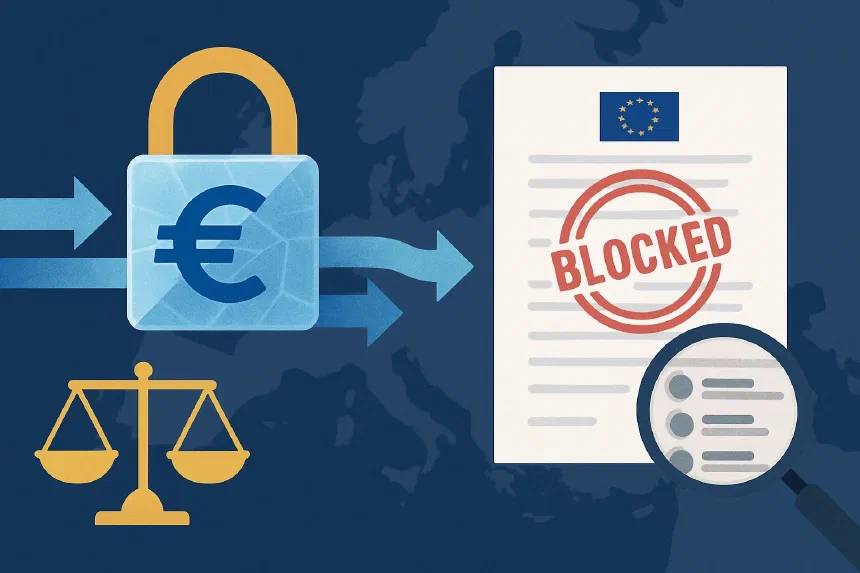
Your company has just received a bank transfer from a counterparty. Or it is about to pay an invoice to a foreign supplier. And then it turns out that the entity appears on the EU sanctions list. What now? You may neither transfer the money onwards nor return the funds without a specific authorisation — because EU law mandates the freezing of assets and applies directly to every company on the territory of the Union.1
Legal status as of: 2026-05-20.
TL;DR — the key points in 90 seconds
- Asset freeze is an obligation arising from Council Regulation (EU) No 269/2014 — it applies to every company in the EU, regardless of sector or size.1
- Freeze ≠ confiscation — the funds still belong to the sanctioned entity, but nobody may touch them or make new resources available to it.
- Two simultaneous prohibitions: you may not deal with the funds of a listed entity (e.g. its deposit held by you) and you may not make new resources available to it (e.g. transfer money to it).1
- When you detect a hit: halt the payment or delivery, do not return any advance without authorisation, and report to the competent authority.
- Authorisation (derogation) is possible — but requires an application to the national authority and is not automatic.
- Penalty for breach: up to PLN 20,000,000, imposed by the Head of the National Revenue Administration (Szef Krajowej Administracji Skarbowej, KAS).2
- The EU sanctions list contains over 2,500 individual entries (position after the 18th package, July 2025) and continues to grow.3
What an asset freeze is
An asset freeze is one of the key restrictive measures provided for in Council Regulation (EU) No 269/2014 of 17 March 2014 concerning restrictive measures in respect of actions undermining or threatening the territorial integrity, sovereignty and independence of Ukraine.1 The regulation is directly applicable in all EU Member States without any need for transposition into national legislation.4
In plain language: if a person or company appears in Annex I to Regulation No 269/2014, all of their funds and economic resources that come into your hands — as a receivable, deposit, advance payment, or goods held in storage — must remain frozen. You may not freely deal with them or return them without authorisation from the competent authority.
The term “funds” covers cash, cheques, claims, letters of credit, and more broadly all assets from which money can be obtained. “Economic resources” are tangible assets — real estate, goods, intellectual property rights — from which the sanctioned entity could obtain funds, goods or services. The scope is very broad and covers situations that do not, at first glance, call to mind a “frozen bank account”.
The ownership rule also applies to related entities: if a sanctioned person holds more than 50% of the shares in a company, that company itself is also treated as subject to the asset freeze.5 This means that even if your counterparty’s name does not appear directly on the list, you may still be dealing with the funds of a sanctioned entity.
Freeze versus confiscation — the crucial distinction
This distinction is fundamental and frequently a source of confusion. An asset freeze does not mean a transfer of ownership — the funds still formally belong to the sanctioned entity. Nobody takes them away. Legal title remains unchanged.
What changes? The ability to use them. An entity on the list cannot withdraw money from its accounts, sell real estate, collect receivables, or in any other way benefit from its assets. You as a company — if you hold any funds or property belonging to such a person — are required to keep them frozen.
Confiscation (or forfeiture of assets) is a separate institution of criminal law that requires a court judgment. Directive (EU) 2024/1226 of 24 April 2024 on the definition of criminal offences and penalties for the violation of Union restrictive measures6 introduces criminalisation of violations and creates grounds for the confiscation of property as a penalty — but only after a final judgment of a criminal court. A freeze is a temporary administrative measure; confiscation is the consequence of a criminal conviction.
The practical implication of this distinction: you cannot independently decide what to do with the funds that have come into your possession. You may not return them to their owner (that would violate the prohibition on making funds available), but you are not their owner either. You hold them under compulsory block — until an authorisation is granted or the entity is delisted.
Two dimensions of a freeze: the prohibition on dealing and the prohibition on making funds available
Article 2 of Regulation No 269/2014 establishes two separate prohibitions that together constitute what is known as an asset freeze.1
The prohibition on dealing with funds (freeze) applies to assets that are owned by, held by, or under the control of a sanctioned entity. If you run a travel agency and a client paid an advance — and it subsequently turns out that the client is on the list — that advance is “frozen”. You may not book it as income, use it for current operations, or return it without authorisation.
The prohibition on making funds available (making funds available) is the other dimension of the same provision. It prohibits the transfer — directly or indirectly — of any funds or economic resources to a sanctioned entity. If you have an invoice to pay to a Russian supplier who has appeared on the list, the transfer is prohibited. Even if delivery has already been completed. Even if failure to pay attracts contractual penalties.
Both prohibitions operate simultaneously and independently of each other. A company may breach the first (e.g. by releasing funds from the account of a sanctioned entity), the second (e.g. by transferring money to it for a service), or both at once. This is worth bearing in mind when designing an internal verification procedure — because sanctions list screening before a transaction helps catch both types of risk.
What a company must do when it detects a frozen counterparty
You have discovered that your client or counterparty appears on the sanctions list. Do not panic — but act quickly and in a specific order.
1. Halt the transaction immediately. Do not execute the transfer, do not dispatch the goods, do not sign any addendum to the contract. Any action taken after the moment at which you ought to have known of the ongoing investigation may be treated as a violation.
2. Do not return any funds without authorisation. If you hold an advance payment, deposit, or any other asset belonging to a sanctioned entity, keep it frozen. Returning it without authorisation from the competent authority is equivalent to making funds available — which is itself a breach of the prohibition.1
3. Report the matter to the national authority. In Poland, the authority competent for the sanctions list is the minister responsible for internal affairs (MSWiA — Ministry of Internal Affairs and Administration).7 The Head of the National Revenue Administration (KAS) supervises compliance and imposes penalties.8 Report the detected hit — the mere act of reporting is evidence of good faith and may be significant in any subsequent proceedings.
4. Document every step. Record the date and time of detection, the source of verification, and the actions taken. Enter the hit in your sanctions hit register — documentation is your evidence in the event of an inspection.
5. Seek legal advice. The rules are not unambiguous in every case. If the transaction value is significant or the matter is complex, consult a legal adviser or solicitor specialising in sanctions law before taking any further steps.
Practical scenarios
Scenario 1: Advance payment from a listed client
A client has paid you an advance of PLN 50,000 for a service. A few days later — during routine verification or as a result of a bank check — it turns out that the client appears on the EU sanctions list.
What happens? The funds that arrived in your account are, by operation of law, “frozen”. You may not spend them. You may not return them to the client. You must keep them frozen and report the matter to the authority.
May you perform the service? No — doing so would constitute making economic resources (your work, your services) available to a sanctioned entity, which is separately prohibited. You may suspend the contract and await further instructions from the authority, or apply for a derogation.
May the client demand a refund? Formally yes — but you may not return the funds without authorisation from the competent national authority. The risk of a civil dispute exists, but it does not alter the content of your public-law obligation.
Scenario 2: A payable owed to a listed supplier
A supplier completed a delivery of goods three months ago. The invoice is overdue. It now turns out that the supplier has appeared on the sanctions list — possibly before they issued the invoice, possibly after.
What happens? The transfer is prohibited regardless of when the delivery took place and regardless of any contractual obligation you may have. Making funds available to a sanctioned entity is an absolute prohibition — the date of delivery and the invoice date are irrelevant.1
Will you face contractual penalties? Probably, if the contract provides for them. However, the obligation arising from an EU regulation takes precedence over a contractual obligation between the parties — breaching sanctions constitutes a breach of a directly applicable provision of European Union law.4 You may consider invoking a force majeure clause or a material change of circumstances — this depends on the wording of the contract and a lawyer’s assessment.
What should you do with the invoice? Suspend payment, document the reason, and apply for a licence to release the funds (derogation), if the circumstances warrant it.
Licences and derogations — when funds may be released
Regulation No 269/2014 provides for the possibility of granting a licence for certain transactions that would otherwise be prohibited.1 In Poland, the authority competent to issue such licences is the minister responsible for internal affairs (MSWiA)7, acting within the procedures set out in the Act of 13 April 2022 on special solutions for counteracting the support of aggression against Ukraine and for the protection of national security (Journal of Laws 2022, item 835).9
When is a derogation possible? The Regulation provides for, among other things:
- Basic needs — release of funds to meet the basic daily needs of a sanctioned natural person (food, rent, medicine). This derogation has limited application for companies.
- Pre-listing obligations — funds intended to settle obligations arising from contracts concluded before the date on which the entity was listed. This is the derogation of most practical relevance to businesses.
- Extraordinary expenses — justified extraordinary expenses, with prior approval of the authority.
The procedure is as follows: you submit an application to the competent national authority, describe the circumstances in detail, and explain why the transaction falls within the permitted exception. The authority has time to consider the application — do not act without a response. You proceed at your own risk if you do not wait for the decision.
Important: authorisation is not automatic and is not guaranteed. The authority may refuse, may request additional documents, or may make the authorisation conditional on the fulfilment of certain requirements. Therefore, if you anticipate regular dealings with entities from high-risk countries, it is worth building an internal procedure in advance, rather than only at the moment of a crisis. You can read more about counterparty verification in the article on counterparty verification for sanctions purposes.
Penalties for breaching the freeze obligation
Breaching the asset freeze obligation or the prohibition on making funds available is one of the most serious violations of sanctions law. Liability is multi-layered.
Administrative penalty — the Head of the National Revenue Administration (KAS) may impose a financial penalty of up to PLN 20,000,000.2 It is imposed by way of an administrative decision and does not require the initiation of criminal proceedings.8
Criminal liability — Directive (EU) 2024/1226 of 24 April 20246 obliges EU Member States to criminalise sanctions violations. The implementation deadline expired on 20 May 2025.10 For violations involving funds or economic resources of significant value, the Directive requires a maximum term of imprisonment of at least five years.11 Poland is implementing the Directive through a legislative bill — the current status of that bill as at the date of publication should be verified with the Government Legislation Centre (RCL).6
Invalidity of contracts — a contract concluded with a sanctioned entity is void by operation of law. You cannot pursue claims arising from such a contract through ordinary means.
It is worth noting that having no sanctions verification procedure at all is treated as an aggravating, not a mitigating, circumstance. “I did not know” does not exempt you from liability if you cannot demonstrate that you took reasonable steps to verify your counterparty. A detailed description of penalties and liability can be found in the article Penalties for Breaching EU Sanctions.
FAQ — frequently asked questions
Does an asset freeze apply to my small business?
Yes. Regulation No 269/2014 does not provide for any monetary threshold or minimum company size.1 Every natural and legal person carrying on an activity in the territory of the EU is subject to this provision. It makes no difference whether you are a sole trader, a limited liability company with five employees, or a corporation with a thousand.
What is the 50% rule and how does it affect my counterparties?
If a sanctioned natural or legal person holds more than 50% of the shares or proprietary rights in a given company, that company is treated as a sanctioned entity — even if its name does not appear on the list.5 This means that verifying just the company name may not be sufficient: you also need to check the ownership structure. Such an analysis is complicated by the fact that ownership is often multi-layered — which is why screening tools should take ownership links into account.
Must I return an advance to a listed client?
You cannot do so without authorisation from the national authority. Returning funds to a sanctioned entity is treated as “making funds available” — which is prohibited in exactly the same way as sending a fresh transfer.1 You must keep the advance frozen and report the matter to the competent authority. You may then apply for a derogation.
What if my bank blocked a transfer but I did not know about the sanctions?
A bank block is a signal that something is amiss — not an automatic resolution of the problem. You must take action yourself: verify the counterparty against sanctions lists, document the result of the verification, and report any hit to the authority. The fact that the bank reacted does not replace your own compliance obligation.
How long must I retain verification documentation?
For entities that are obliged institutions under the Act of 1 March 2018 on counteracting money laundering and the financing of terrorism, the AML Act specifies a five-year retention period for documentation.12 For other companies, the general rules apply — as a cautious minimum it is advisable to adopt the same five-year period by analogy, documenting each verification with the date and outcome.
Do sanctions apply to deliveries completed before the listing date?
It depends on when the entity was listed. If both delivery and payment took place before the listing — the transaction was lawful at the time it was carried out. If payment falls due after the listing and delivery was made earlier — the transfer is still prohibited. The Regulation prohibits the current making of funds available; it is not limited to transactions entered into after the listing date.1 In such situations it is advisable to apply for a derogation, citing obligations arising from contracts concluded before the listing date.
How Sanqto can help
An asset freeze is a scenario that can be effectively anticipated. Sanqto is sanctions screening software installed within your company’s own infrastructure — counterparty data never leaves your network. The system checks counterparties against EU sanctions lists (including the Consolidated List covering entities subject to Regulation No 269/2014), the MSWiA list, and selected global lists, returning a result in three states: MATCH, POSSIBLE, or CLEAR. Such verification before each transaction helps reduce the risk of inadvertently breaching the freeze obligation and builds the compliance documentation needed in the event of an inspection. If you run a business in the real estate, tourism, or leasing sector — where transactions are high-value and sanctions risk is real — see how Sanqto supports real estate agencies and companies in the tourism sector.
Legal basis
- Council Regulation (EU) No 269/2014 of 17 March 2014 concerning restrictive measures in respect of actions undermining or threatening the territorial integrity, sovereignty and independence of Ukraine (Art. 2(1)–(2) — asset freeze and prohibition on making funds available) — CELEX 32014R0269
- Council Regulation (EU) No 833/2014 of 31 July 2014 concerning restrictive measures in view of Russia’s actions destabilising the situation in Ukraine — CELEX 32014R0833
- Act of 13 April 2022 on special solutions for counteracting the support of aggression against Ukraine and for the protection of national security (Journal of Laws 2022, item 835, Arts. 2, 3, 6(2)) — eli.gov.pl
- Directive of the European Parliament and of the Council (EU) 2024/1226 of 24 April 2024 on the definition of criminal offences and penalties for the violation of Union restrictive measures (Arts. 3(1), 5(3), 20(1)) — CELEX 32024L1226
- Act of 1 March 2018 on counteracting money laundering and the financing of terrorism (Art. 49 — document retention period) — eli.gov.pl
- List of persons and entities subject to sanctions maintained by MSWiA (Ministry of Internal Affairs and Administration) — gov.pl
- EU Consolidated Financial Sanctions List — webgate.ec.europa.eu/fsd/fsf
Footnotes
Information, not legal advice. This article is for informational and educational purposes only. It does not constitute legal advice. Legal status as of: 20 May 2026. Your company’s specific obligations depend on its activity profile and require individual assessment — if in doubt, consult a lawyer or compliance adviser.
Council Regulation (EU) No 269/2014 of 17 March 2014, Art. 2(1)–(2): “All funds and economic resources belonging to, owned, held or controlled by the natural or legal persons, entities or bodies listed in Annex I shall be frozen. No funds or economic resources shall be made available, directly or indirectly, to or for the benefit of the natural or legal persons, entities or bodies listed in Annex I.” — EUR-Lex CELEX 32014R0269 ↩︎ ↩︎ ↩︎ ↩︎ ↩︎ ↩︎ ↩︎ ↩︎ ↩︎ ↩︎ ↩︎
Act of 13 April 2022, Art. 6(2): “A financial penalty is imposed by the Head of the National Revenue Administration (Szef Krajowej Administracji Skarbowej), by way of a decision, of up to PLN 20,000,000.” — eli.gov.pl ↩︎ ↩︎
After the 18th sanctions package (July 2025) the number of individual entries on the EU Consolidated List exceeded 2,500. The 19th and 20th packages (up to May 2026) added further entries. — EU adopts 18th package of sanctions against Russia, finance.ec.europa.eu ↩︎
EU Regulations are directly applicable in all Member States — Art. 288 TFEU: “A regulation is binding in its entirety and directly applicable in all Member States.” — EUR-Lex, Regulation — EU legal act ↩︎ ↩︎
DG FISMA FAQ — ownership rule: “An entity is considered as ‘owned’ by a sanctioned person if the latter owns more than 50% of its proprietary rights.” — finance.ec.europa.eu ↩︎ ↩︎
Directive of the European Parliament and of the Council (EU) 2024/1226 of 24 April 2024 on the definition of criminal offences and penalties for the violation of Union restrictive measures and of the facilitation of such violations, and amending Directive (EU) 2018/1673 — EUR-Lex CELEX 32024L1226 ↩︎ ↩︎ ↩︎
Act of 13 April 2022, Arts. 2(1) and 3(1): “The list of persons and entities against whom the measures referred to in Art. 1 are applied, hereinafter referred to as ’the list’, is maintained by the minister responsible for internal affairs (MSWiA). The minister responsible for internal affairs issues decisions on inclusion in and removal from the list.” — eli.gov.pl ↩︎ ↩︎
Act of 13 April 2022, Art. 6(2): “A financial penalty is imposed by way of a decision by the Head of the National Revenue Administration (Szef Krajowej Administracji Skarbowej, KAS).” — api.sejm.gov.pl/eli/acts/DU/2022/835 ↩︎ ↩︎
Act of 13 April 2022 on special solutions for counteracting the support of aggression against Ukraine and for the protection of national security (Journal of Laws 2022, item 835, entry into force: 16.04.2022, consolidated text available) — eli.gov.pl ↩︎
Directive (EU) 2024/1226, Art. 20(1): “Member States shall bring into force the laws, regulations and administrative provisions necessary to comply with this Directive by 20 May 2025.” — EUR-Lex CELEX 32024L1226 ↩︎
Directive (EU) 2024/1226, Art. 5(3)(b): “the offences referred to in Article 3(1)(a), (b) and (h)(i) and (ii) are punishable by a maximum term of imprisonment of at least five years” — applies to violations involving funds or economic resources with a value of at least EUR 100,000 — EUR-Lex CELEX 32024L1226 ↩︎
Act of 1 March 2018 on counteracting money laundering and the financing of terrorism, Art. 49: “Obliged institutions shall retain [documentation] for a period of five years, counted from the first day of the year following the year in which the business relationship ended.” — eli.gov.pl ↩︎